Whether to keep saving in dollars comes down to two things, and the answer differs from person to person. First, how much has the dollar fallen against your currency? By the Federal Reserve's broad dollar index, the dollar lost about 6.4% overall between 2 January 2025 and 23 October 2026, but it fell about 18% against the Brazilian real and about 10% against the Korean won, barely moved against the yen, and rose about 11% against the Indian rupee. Second, what will you spend this money on? If it will pay for tuition, travel or a loan in dollars, the exchange rate hardly matters to you; only money you will convert back into your own currency carries the exchange-rate risk. Dollars sitting still also lose to inflation, which was 3.7% in the US in September 2026, while the 13-week Treasury bill yielded about 4.11% at the same time, so dollars that earn interest can absorb part of any currency move.
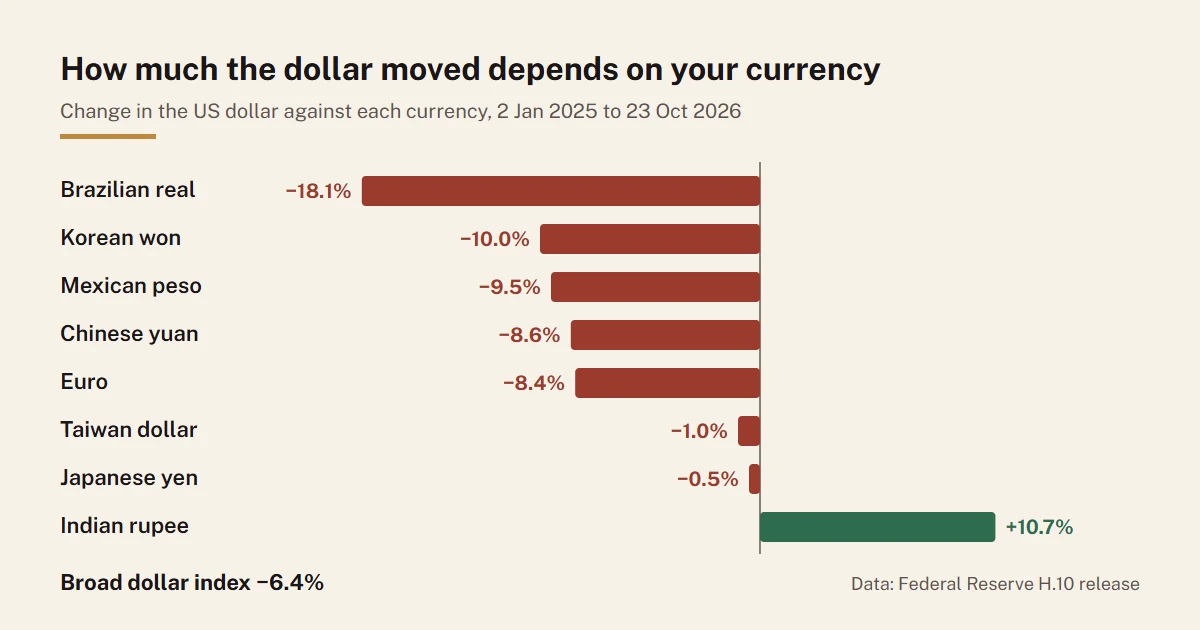
How much the dollar has lost: it depends on the currency
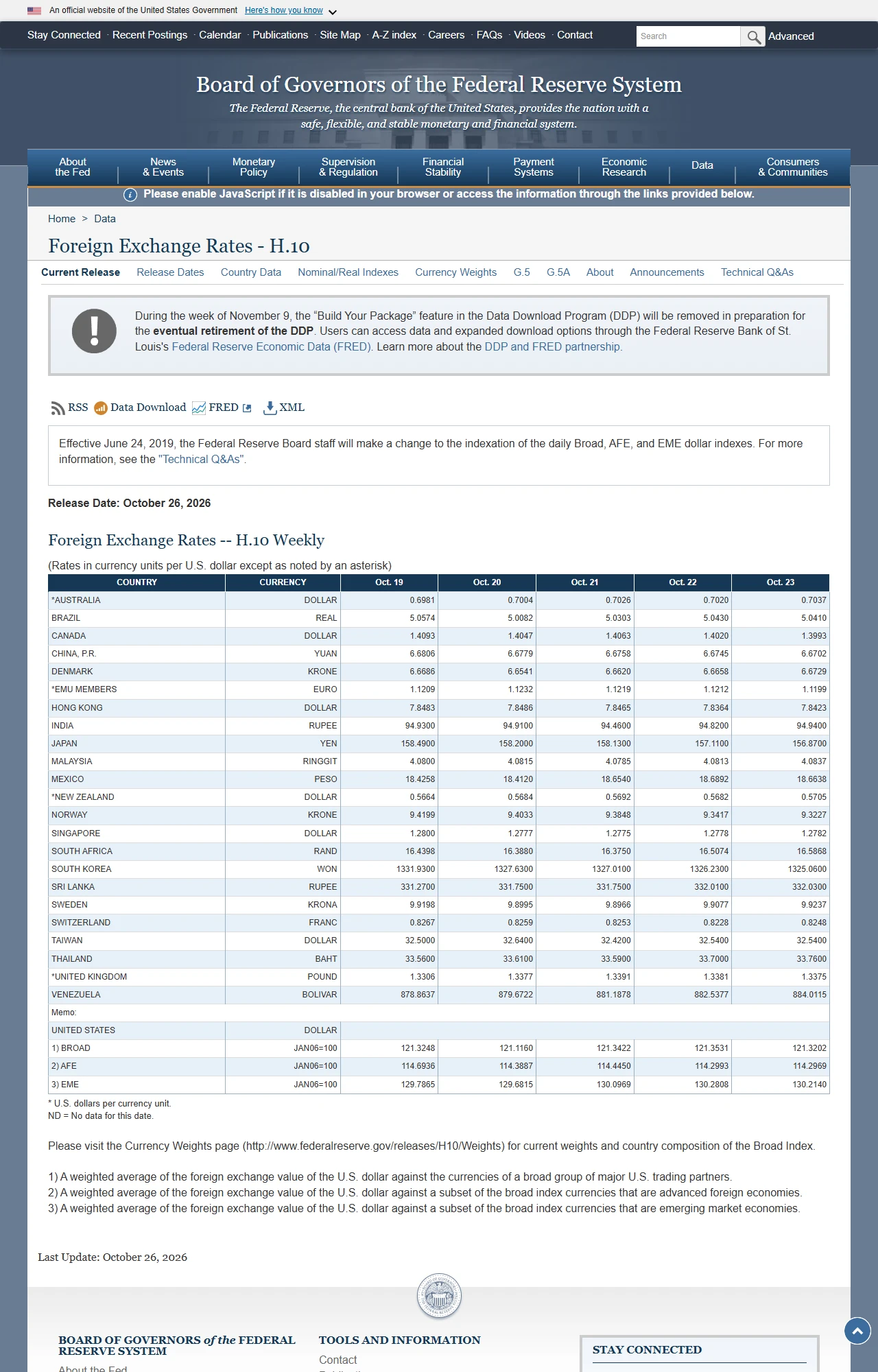
When the news says the dollar is weakening, it usually means a dollar index has fallen. The Federal Reserve's broad dollar index is a trade-weighted average of the dollar against the currencies of major US trading partners, set to 100 in January 2006. On 2 January 2025 it stood at 129.67, above its level in late October 2022 (128.20 on 24 October). By 31 December 2025 it had dropped to 120.12, a fall of about 7.4% in a year. Since the start of 2026 it has recovered about 1%, reaching 121.32 on 23 October.
Underneath that average, currencies went very different ways. The table uses the Fed's noon buying rates in New York; the last three columns show the change in the dollar against each currency, so a negative number means the dollar got cheaper:
| Currency | 2 Jan 2025 | 31 Dec 2025 | 23 Oct 2026 | 2025 | 2026 so far | Total |
|---|---|---|---|---|---|---|
| Broad dollar index | 129.67 | 120.12 | 121.32 | −7.4% | +1.0% | −6.4% |
| Chinese yuan (per dollar) | 7.2994 | 6.9931 | 6.6702 | −4.2% | −4.6% | −8.6% |
| Euro (dollars per euro) | 1.0261 | 1.1736 | 1.1199 | −12.6% | +4.8% | −8.4% |
| Japanese yen (per dollar) | 157.65 | 156.80 | 156.87 | −0.5% | 0.0% | −0.5% |
| Taiwan dollar (per dollar) | 32.88 | 31.37 | 32.54 | −4.6% | +3.7% | −1.0% |
| Indian rupee (per dollar) | 85.75 | 89.84 | 94.94 | +4.8% | +5.7% | +10.7% |
| Korean won (per dollar) | 1472.52 | 1444.55 | 1325.06 | −1.9% | −8.3% | −10.0% |
| Mexican peso (per dollar) | 20.625 | 18.006 | 18.664 | −12.7% | +3.7% | −9.5% |
| Brazilian real (per dollar) | 6.1556 | 5.4770 | 5.0410 | −11.0% | −8.0% | −18.1% |
The same “weaker dollar” looks very different by currency. Measured in euros, the dollar lost more than a tenth in 2025 and then won some of it back in 2026; measured in yen, it has gone almost nowhere for nearly two years; measured in Indian rupees, it has gained a tenth. To judge your own exposure, look at the dollar against the currency you actually hold, not at the index. The rate your bank gives you also includes a buy-sell spread, so it will be a little worse than the figures here; the arithmetic is in how to calculate the FX spread.
Two kinds of “losing value”: keep them apart
The first is the exchange rate: a dollar buys less of another currency, which is what the table above shows. It only becomes a real gain or loss when you convert dollars into something else. If you keep spending in dollars, the exchange rate does not touch you.
The second is purchasing power: the same $100 buys fewer things, because of inflation, and everyone holding dollar cash bears it. US consumer prices were 3.7% higher in September 2026 than a year earlier, so dollars in an account that pays nothing lost about that much buying power over the year. This one applies wherever you live and whatever currency you spend; the history and arithmetic are in how inflation eats your savings and the dollar buying power calculator.
Put the two together to see the whole picture. If the dollar falls against your currency and your dollars earn nothing, you lose on both counts. If the dollar falls but your dollars sit in Treasury bills paying around 4% a year, the interest covers inflation, and what is left depends on how far the dollar fell.
What the money is for decides whether the exchange rate matters
- Money you will spend in dollars anyway: tuition abroad, medical bills overseas, travel, import payments, a dollar mortgage or student loan. There is no need to convert it because the dollar is weaker; converting out and back in later means paying the spread twice.
- Money you will convert back to your own currency: this is the part that carries exchange-rate risk. If the dollar falls 5% against your currency, you get 5% less when you convert, and the next section shows how much interest can make up.
- If your currency has tended to weaken against the dollar: like the Indian rupee in the table, against which the dollar rose a tenth in under two years. In places like this, keeping part of your savings in dollars still spreads risk; set the share by your own spending.
- If you only want to diversify: without a real dollar expense, there is no need for a large share. To decide how much belongs in dollars and where, use the three questions in where to hold dollars by use case.
How much interest can offset a falling dollar
Take $10,000 and assume a year at the 13-week Treasury bill's coupon-equivalent yield of about 4.11% on 28 October 2026, rolled over at maturity, before tax and conversion spreads. Converted back to your own currency after a year, compared with the start:
| Dollar against your currency over the year | In Treasury bills (about 4.11%) | In an account paying nothing |
|---|---|---|
| Up 5% | +9.3% | +5.0% |
| Unchanged | +4.1% | 0% |
| Down 3% | +1.0% | −3.0% |
| Down 6% | −2.1% | −6.0% |
| Down 10% | −6.3% | −10.0% |
The formula is 1.0411 × (1 + the dollar's change) − 1. The break-even is a fall of about 3.9% in a year: if the dollar falls less than that, interest-earning dollars still come out ahead in your own currency; if it falls more, the interest is not enough. Dollars that earn nothing lose the full exchange-rate move, and inflation on top. So when the dollar weakens, the first thing to check is whether your dollars are earning interest.
Local banks often pay less on dollar deposits than Treasury bills do. Bank of Taiwan's posted one-year USD time deposit rate in September 2026 was 2.05%, which only covers a fall of about 2%. How to buy T-bills and dollar money market funds is in money market funds and T-bills for non-US residents.
What to do with your dollars when the dollar is falling
- Split your dollars by purpose: leave alone the part you will spend in dollars, and look separately at the part you will convert back.
- Check that every dollar is earning interest. Move money sitting in a current account, in cash or in a wallet into time deposits, Treasury bills or a money market fund; interest is the most direct offset to a currency move.
- If you need to convert back, do it in several steps rather than all in one day. Exchange rates swing in the short run, and converting everything at once bets the result on a single day's price.
- Convert between accounts at the spot rate, not with banknotes. The buy-sell spread on cash is usually much wider; there is an example in USD time deposit tips and common traps.
- Do not borrow or use leverage to bet on the dollar's direction. If someone says the dollar is about to collapse and you must switch into their product now, treat it as a sales pitch; common scams are in scams and account safety.
- Set a target share and review it once a year. Rebalance only when you drift well away from it, rather than trading on each day's headlines.
Will the dollar keep falling?
Nobody can say, and this site does not forecast exchange rates. What the record shows is that the dollar moves in cycles: the broad index was around 128 in October 2022, rose to 129.67 at the start of 2025, fell to about 120 during 2025 and has edged up since the start of 2026. Over the same period it moved in opposite directions against different currencies; the Indian rupee and the Brazilian real in the table are two examples.
Interest on dollar savings follows US interest rates. On 28 October 2026 the Federal Reserve held the target range for the federal funds rate at 3.75% to 4%. Where rates go next will change what Treasury bills and dollar deposits pay, and so the break-even in the previous section. Rather than guessing the direction, get the steps above in place so that your dollars earn interest whichever way the rate moves.
Common questions
Sources
- Federal Reserve: H.10 foreign exchange rates, release of 26 October 2026
- Federal Reserve: H.10 foreign exchange rates, release of 6 January 2025
- Federal Reserve: H.10 foreign exchange rates, release of 5 January 2026
- Federal Reserve: H.10 foreign exchange rates, release of 31 October 2022
- Federal Reserve: FOMC statement, 28 October 2026
- US Bureau of Labor Statistics: Consumer Price Index, September 2026
- US Treasury: Daily Treasury bill rates