No. A stablecoin pays no interest on its own: USDT or USDC sitting in a wallet or an exchange account never grows by a single coin. The “3% APY” or “flexible savings” you see on an exchange or app is either a reward the platform pays separately or money it earns by lending your coins to someone else, and it has nothing to do with the stablecoin itself. The US GENIUS Act, signed in 2025, goes further and bars issuers from paying holders interest at all. Before you put dollars into a stablecoin yield product, find out three things: who is paying the yield, what happens to your coins, and where you stand if the platform fails. If safety is the point, the 13-week US Treasury bill had a coupon-equivalent yield of about 4.18% on 16 October 2026, and it is paid by the US government rather than a platform's promise.
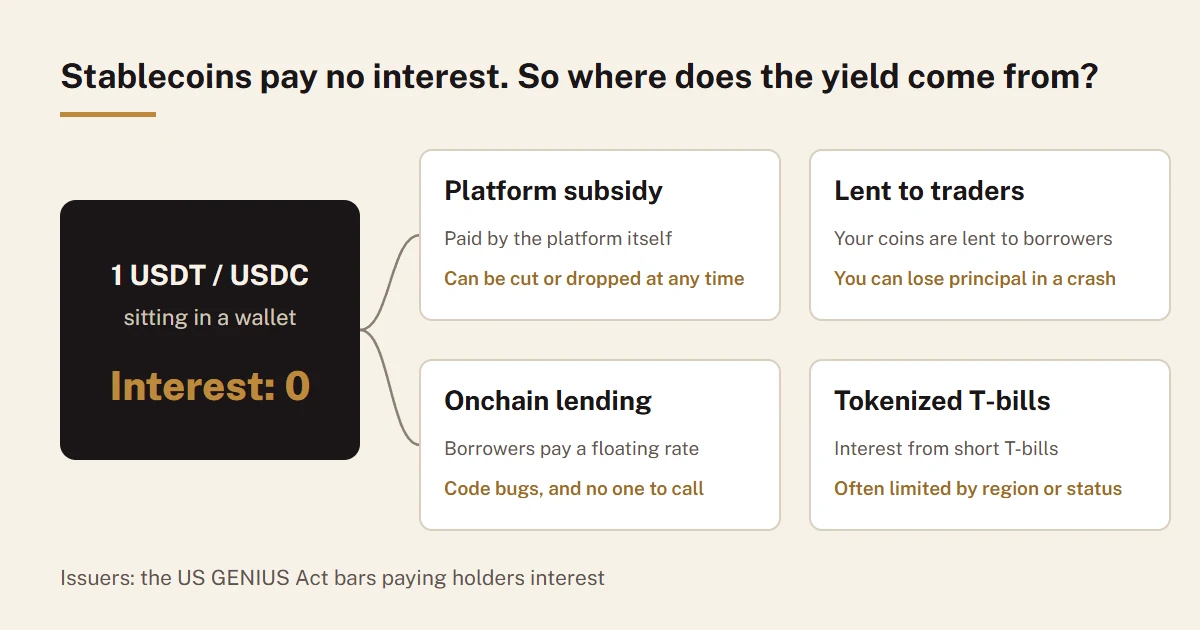
Where stablecoin yield comes from: four sources compared
| Source | Who pays | Where your coins go | If something goes wrong |
|---|---|---|---|
| Platform rewards (e.g. Coinbase USDC Rewards) | The platform itself; Coinbase calls it a loyalty program it funds | They stay in your account; Coinbase says it does not use them without your instruction | The balance is not a deposit and has no FDIC or SIPC insurance |
| Exchange earn products (e.g. Binance Simple Earn Flexible) | A rate the platform sets and can change at any time | They may be lent to other users through margin and crypto loan products | The platform warns of possible loss of principal in extreme markets; flexible redemptions have daily limits |
| Onchain lending | Borrowers, at a rate that floats with demand | Into a smart contract that lends them to borrowers who post other coins as collateral | A code bug or failed liquidation can cost you principal, with no support desk to call |
| Tokenized Treasury funds and yield-bearing dollar tokens | Interest on the underlying short-term Treasuries | You hold a fund share or security, not an ordinary stablecoin | Usually limited by investor status or region; redemptions follow the fund's rules |
On the same platform, USDT and USDC often earn different rates. The difference is not in the coins but in how much subsidy the platform has to spend and how much borrowers will pay to borrow each one. A higher rate on one coin says nothing about which coin is safer; reserve, redemption and freeze risks are a separate question, covered in stablecoin risks.
Why stablecoin issuers don't pay you interest
When an issuer takes your dollars, it holds the reserves in short-term Treasuries and bank deposits, and the interest goes to the issuer. Circle, which issues USDC, reported reserve income of $668 million for the second quarter of 2026, and distribution, transaction and other costs of $412 million in the same quarter, with the increase driven mainly by distribution payments. In other words, a large share of what the reserves earn flows to distribution partners such as exchanges, and that share is one way an exchange can fund the rewards it pays you. That last step is an inference from the structure of the results; Circle does not name the partners.
Section 4(a)(11) of the GENIUS Act (Public Law 119-27, signed on 18 July 2025) says a permitted or foreign payment stablecoin issuer may not pay a holder any form of interest or yield, whether in cash, tokens or other consideration, solely in connection with holding, using or retaining the stablecoin. The Act takes effect on the earlier of two dates: 18 months after enactment, which is 18 January 2027, or 120 days after regulators issue final implementing rules.
The ban covers issuers. It does not name exchanges, so an exchange paying holders rewards out of its own money is outside it for now. That gap is exactly what Congress has since been arguing about; see the rules are still moving below.
The Act has one more provision that matters to holders: if an issuer fails, holders have priority over other creditors on the required reserves, shared ratably (Section 11). That protects your claim against the issuer. If coins you put into an exchange earn product are lost because the exchange fails, your claim is against the exchange, and this provision does not help.
How exchange “USDT savings” rates are funded
Binance's Simple Earn FAQ is unusually plain about it: the rate is set by Binance at its discretion; the real-time APR can change every minute; deposited assets may be used for a variety of purposes, for example lent to other users through margin and crypto loan products; principal can be lost in extreme market conditions; and each flexible product has a daily redemption limit that can change at any time.
Coinbase's USDC Rewards work differently. Its help page describes them as a loyalty program funded by Coinbase to encourage customers to hold USDC on Coinbase, and says Coinbase does not use or lend your USDC without your instruction. The same page opens by saying USDC balances are not deposit accounts and are not insured by the Federal Deposit Insurance Corporation (FDIC) or the Securities Investor Protection Corporation (SIPC). To earn the rewards you have to be in one of the listed regions, and in the United States, the United Kingdom, Australia, Singapore and a few others you also need a paid Coinbase One membership.
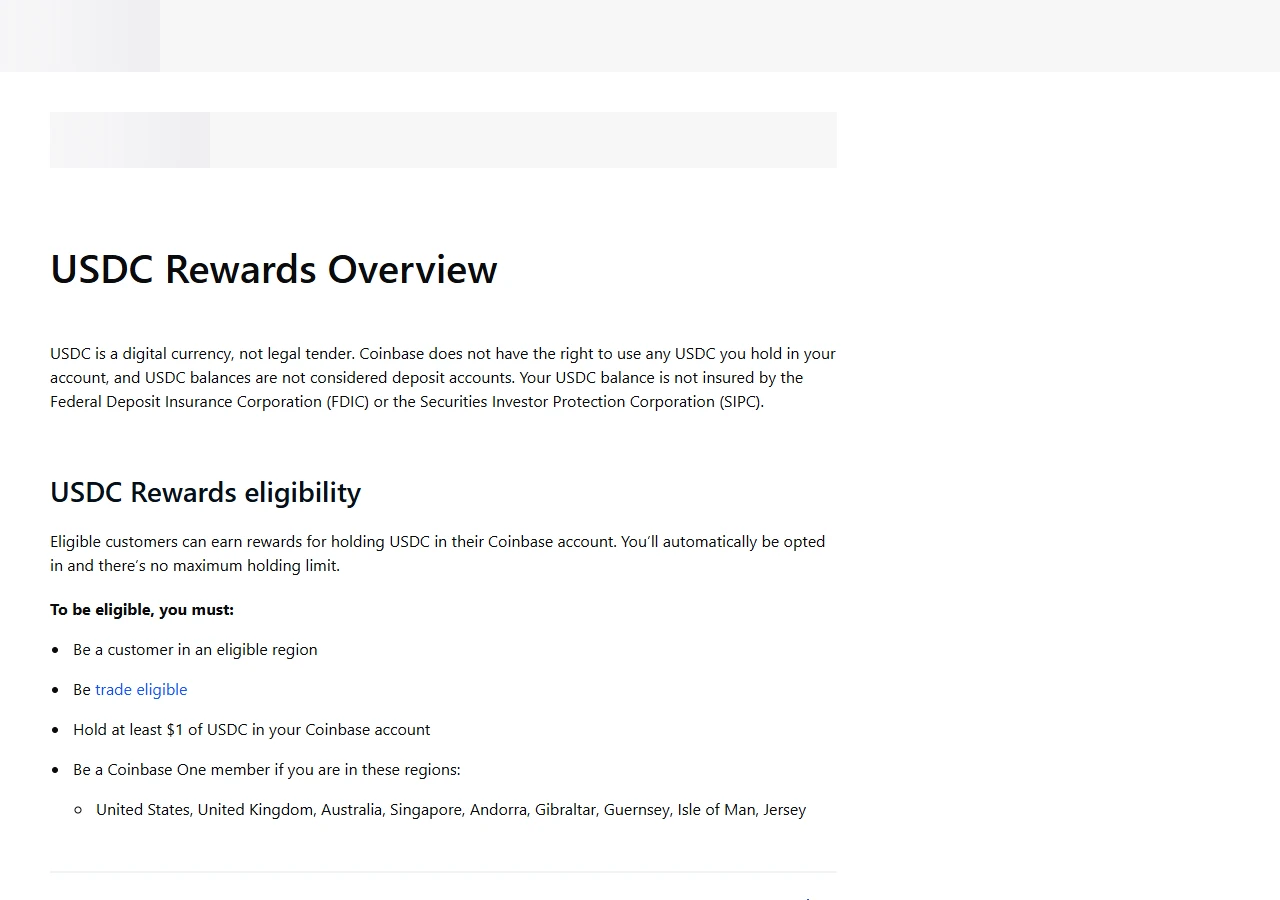
The difference is where the money comes from. When your coins are lent out, part of the yield is interest paid by borrowers, and if borrowers default or the platform's risk controls fail, the loss can land on the people who deposited. When the platform pays a subsidy, your coins stay put, but the platform decides the rate and can cut or end it. Work out which kind you are using before you compare the numbers.
What happened to the platform that paid 18%
Celsius in 2022 is the case people still point to. According to a July 2023 announcement by the US Federal Trade Commission (FTC), Celsius advertised its Earn program at up to 18% APY, and its founders told customers the platform carried less risk than a bank. In fact the company misappropriated more than $4 billion of customer assets, had made $1.2 billion in unsecured loans as of April 2022, and did not have the $750 million deposit insurance policy it claimed. Celsius froze withdrawals and filed for bankruptcy in July 2022. The FTC's $4.7 billion judgment against the company was suspended so that its remaining assets could go back to customers through the bankruptcy.
What customers faced in the end was not a smaller interest payment but their principal waiting in line in a bankruptcy. When a stablecoin rate sits far above short-term Treasuries, the first question is who is paying the difference, and how they can afford it.
Stablecoin yield vs Treasury bills and money market funds
| Option | Yield reference | Who pays | Getting your money |
|---|---|---|---|
| 13-week US Treasury bill | About 4.18% coupon equivalent (16 Oct 2026) | The US government | Principal and interest at maturity, or sell in the market before then |
| 26-week US Treasury bill | About 4.35% coupon equivalent (16 Oct 2026) | The US government | Same as above |
| Exchange stablecoin earn product | Set by the platform; flexible rates can change by the minute | The platform, and the borrowers | Daily redemption limits on flexible products; locked products pay out at the end of the term |
| Platform USDC rewards | Set by the platform; varies by region and membership | The platform itself | Balance available at any time |
T-bills and dollar money market funds are bought through a broker. How non-US residents open an account and whether withholding tax applies is covered in money market funds and T-bills for non-US residents. If a platform's stablecoin rate is clearly above Treasuries of the same term, the extra is the price you are being paid to carry risk on the platform's behalf.
Five questions to ask before you deposit
- Who pays the yield: a platform subsidy, borrowers, or interest on underlying Treasuries? If the product page cannot tell you, treat the source as unknown and hold off.
- Will your coins be lent out? Search the terms and FAQ for “lend” and “loan”. If they will, a borrower's default can become your loss.
- Can you take the money out when you want? Check for a daily redemption limit on flexible products, and whether locked products allow early redemption and what you give up for it. Start with a small amount, redeem it the next day, and note how long it takes to reach your available balance.
- Where do you stand if the platform fails? Check whether the terms say the platform holds the coins for you or that you are lending them to the platform. Celsius customers ended up waiting in a bankruptcy queue.
- Is it allowed where you live, and is it taxable? Some countries do not allow these products to be offered to residents, and some treat the rewards as income. Check your local rules and keep the date and amount of every payout.
If you can answer all five, the rate is worth considering. If you cannot answer one of them, it is better to keep the money somewhere that pays nothing but lets you withdraw, or to use Treasury bills or a money market fund instead. How to combine different places is covered in where to hold dollars by use case.
The rules are still moving: will exchange stablecoin rewards be banned?
In May 2026 Senators Tillis and Alsobrooks agreed compromise language on stablecoin yield in a separate bill, the CLARITY Act, that would bar rewards economically or functionally equivalent to interest on a bank deposit, aimed mainly at rewards paid by exchanges and affiliates. On 15 September 2026 the Senate voted 49 to 50 on whether to proceed to the bill, 11 votes short of the 60 needed, so that restriction did not become law. The bill could still be brought back.
For holders the takeaway is simple: the rewards available today sit in a gap in the rules, and a platform could cut or end them when new rules arrive. Do not plan a year or two around today's rate; treat it as extra income that may disappear.
Common questions
Sources
- US Government Publishing Office: GENIUS Act, Public Law 119-27 (full text)
- Circle: Second quarter 2026 results
- Binance: Simple Earn FAQ
- Coinbase: USDC Rewards overview
- US Federal Trade Commission: Settlement with Celsius Network and charges against former executives
- Office of Senator Alsobrooks: Tillis and Alsobrooks reach compromise on stablecoin yield
- The Defiant: Senate blocks CLARITY Act 49-50
- US Treasury: Daily Treasury bill rates