Choose the destination before you cash out: a fiat balance inside the exchange, your own bank account, or local money paid by a P2P counterparty. A completed sell is not the same as money landing.
Which way the money leaves
An exchange sale exits as “USDT → fiat balance in the account → bank”, so the sale and withdrawal have separate statuses. P2P exits as “USDT in escrow → the buyer pays your receiving account → you confirm and release”, so the actual credit and the source of the buyer's money matter. An OTC desk quotes and arranges a larger settlement directly, with a higher entry threshold and more responsibility on you to assess the desk.
Not every route works everywhere. Which one is available where you live, and whether it leaves a trade record, decides what you can actually use. If the money is still in your local currency, start with where to hold US dollars.
First cash-out: a small amount all the way through
Work through it in this order:
- Test small first: run the whole "sell, withdraw, land" chain once with an amount you could fully afford to lose
- Stick to regulated, record-keeping routes only: an exchange sell or an escrowed P2P trade, skip offline deals or "a friend recommended" private channels
- Keep records of the entire trade: save the order number, trade screenshots, transfer records and chat logs, they're your only evidence if something goes wrong
- Confirm it landed before you move on: only once the money is actually in your bank account and you can see it posted should you decide whether to scale up
- Scale in batches: once the full process has proven stable, increase the amount gradually, don't cash out everything you hold in one go the first time
If you plan to use Binance for this step and still need an account, follow the registration and invite-code guide for account creation, identity verification and security settings.
Exchange sale, P2P or an OTC desk
① Sell inside a regulated exchange straight into your account's fiat balance, then withdraw. This is the most standard path: your counterparty is the exchange's own liquidity pool, not a specific person, so the sell itself fills almost at once. The fiat then sits in your account balance, and getting it onto your bank card is a separate withdrawal step, the one that decides how long the whole thing takes. Risk is comparatively lowest, but the barrier is that you need to complete identity verification first, and in some regions a local on/off ramp also has to be available.
② P2P/C2C, trading directly with another person. You post an order or take one, set or pick your own price, and the platform holds your USDT in escrow until the counterparty confirms payment. The upside is more room on price and sometimes a faster landing, since the other side pays your bank card or a third-party payment account directly. The downside is that you're taking on some risk for whether the money coming in is clean; if it turns out to be tied to a problem, it's usually the receiving account, yours, that gets frozen.
③ An over-the-counter (OTC) desk, a one-on-one service. A desk converts a large amount of USDT into local currency directly for you, skipping the wait for a counterparty to show up, with a dedicated contact handling it. The advantage is being able to handle size, with privacy and efficiency; the cost is a higher barrier, many desks set a minimum amount, and you're on your own to judge whether a given desk is legitimate.
| Route | Who you trade with | Barrier | Cost | Speed to land | Main risk |
|---|---|---|---|---|---|
| Exchange sell | The exchange's own fiat order book | Complete verification; a local on/off ramp must be available | Spread + withdrawal fee | Sell near-instant; withdrawal from minutes to a few business days | Comparatively lowest; mainly withdrawal reviews or delays |
| P2P / C2C | Another individual, escrowed by the platform | Just need to send or receive local transfers or third-party payments | Spread usually more flexible; typically no extra withdrawal fee | Fairly fast once the counterparty confirms payment | Frozen funds from tainted money, fake buyers |
| OTC desk | The desk or a dedicated contact | Usually a minimum amount, skews toward larger sums | One-on-one pricing, often better value at volume | Depends on the desk's efficiency, can be quick | You must judge the desk's legitimacy yourself; informal in-person deals carry more risk |
Spreads, fees and timing move with the market and the withdrawal method; the order and withdrawal screens show the current figures.
USDT is a token pegged to the dollar, not legal tender, so cashing out means selling it to someone willing to pay local money: an exchange, a person or a desk. How it relates to the dollar itself is covered in Are stablecoins digital dollars?
What cashing out actually costs
Most people look at cashing out and see one number: the fee line on the withdrawal screen. The cost is three layers stacked on top of each other, and skipping any one of them means whatever total you come up with is wrong.
Layer one, the sell-side spread. The price you actually get when you sell USDT for fiat sits a bit off from the market reference price at that moment; that gap is the platform's or counterparty's margin, and it's your first hidden cost. The tighter the spread, the closer what lands in your account is to the market price. Working out the spread, and whether it's reasonable, isn't a gut call, it's something you can actually calculate.
Layer two, the platform's fee to withdraw fiat to your bank card. Some rails are free, some charge a flat fee per transaction, some take a percentage, and it depends on which withdrawal method you pick: a bank wire, a local instant rail, or a third-party payment channel.
Layer three, the network fee if you move coins first. If you send USDT from one wallet to another platform before cashing out, that transfer carries a network fee (commonly called gas), and the cost can vary several times over depending on which network you use. This step doesn't come up on every cash-out, but the moment a transfer happens, it belongs in your total; don't leave it out.
Add the three together and you have the full cost of cashing out. Here is a sale of 1,000 USDT with assumed numbers, just to show how big each layer is:
| Cost | Assumption | Amount |
|---|---|---|
| Trading fee | Spot trade charged at 0.1% | 1 USDT |
| Sell-side spread | Filled 0.5% below the market reference | 5 USDT |
| Network fee | Moved from your own wallet to the exchange first | About 1 USDT |
| Withdrawal to bank | Free local instant rail | 0 |
| Total | About 0.7% of the amount | About 7 USDT |
In practice the difference comes mostly from the spread and the withdrawal: a P2P price can sit one or two percent below the reference, and a bank wire withdrawal may carry a flat fee. How to work out the spread from the market price is in how to calculate the FX spread, and you can plug your own numbers into the spread calculator.
Is it stuck at the sale, withdrawal or receipt?
USDT sold, but nothing at the bank: first check whether the fiat is still in the exchange balance, then inspect the withdrawal status, recipient details and the processing time shown by the platform. The sale normally finishes only the first leg; the local rail, a cross-border transfer or manual review can delay the second.
A P2P buyer says they paid, but your account shows no credit: do not release from a screenshot or under pressure. Rely on the posted entry in your own bank or payment account, keep the order and chat records, and use the platform's escrow dispute process. Moving the conversation off-platform weakens the evidence available to you.
Your bank account is restricted: ask the bank what records it needs, prepare the order number, trade screenshots and transfer records, and follow the formal process where you live. Do not send more money to anyone offering a paid “unfreeze”. Record-keeping routes and avoiding oddly priced counterparties can reduce risk, but cannot guarantee that a review will never happen.
The cash-out traps and scams
Cash-out scams mostly reuse the same playbook as everywhere else, just dressed up for the moment money is leaving your account, which is exactly when people tend to let their guard down. The common ones: fake buyers, who claim in a P2P chat that they've already paid and show a doctored transfer screenshot to rush you into releasing USDT, only for you to find the money never arrived; fake support, impersonating platform staff and telling you your account looks "abnormal" and needs "verification" as a pretext to phish your password or a one-time code; pay an unlock fee first, a claim that your withdrawal has been frozen by risk controls and you need to pay a fee before it clears, which is close to always a scam; pushed offline meetups, using "safer in person" as the pitch to get you to a physical meeting, where the risk is actually harder to control; and below-market bait, a quote noticeably better than the going rate, aimed squarely at people chasing a deal.
Spotting scams and keeping the account safe are covered in more detail in Scams and account safety.
Plan the exit before you put money in
If you have not bought USDT yet, the best time to plan the exit is before the money goes in.
Ask yourself a few questions: roughly when will you need this money? Will you cash out through an exchange sell or P2P when the time comes? Are there local rules around cashing out that you need to keep in mind? Working these out ahead of time is a lot less stressful than scrambling to catch up after the fact, and it keeps you from discovering the exit doesn't work right when you're in a hurry for the money.
A more practical habit is to split money by purpose: keep anything you might need urgently out of a container with poor liquidity or a slow landing time; money you're not touching for a long while can sit somewhere less sensitive to cash-out cost and speed. For routing dollars by purpose, see where to hold US dollars and choosing by purpose.
Do you owe tax when you cash out?
It depends on where you are tax resident, and the rules differ widely. Take the US: the IRS treats digital assets as property, not currency, and lists stablecoins among them. Selling, swapping or spending them must be reported on your return whether or not you made a gain, and the first page of Form 1040 asks a yes-or-no question about whether you received, sold or exchanged digital assets during the year.
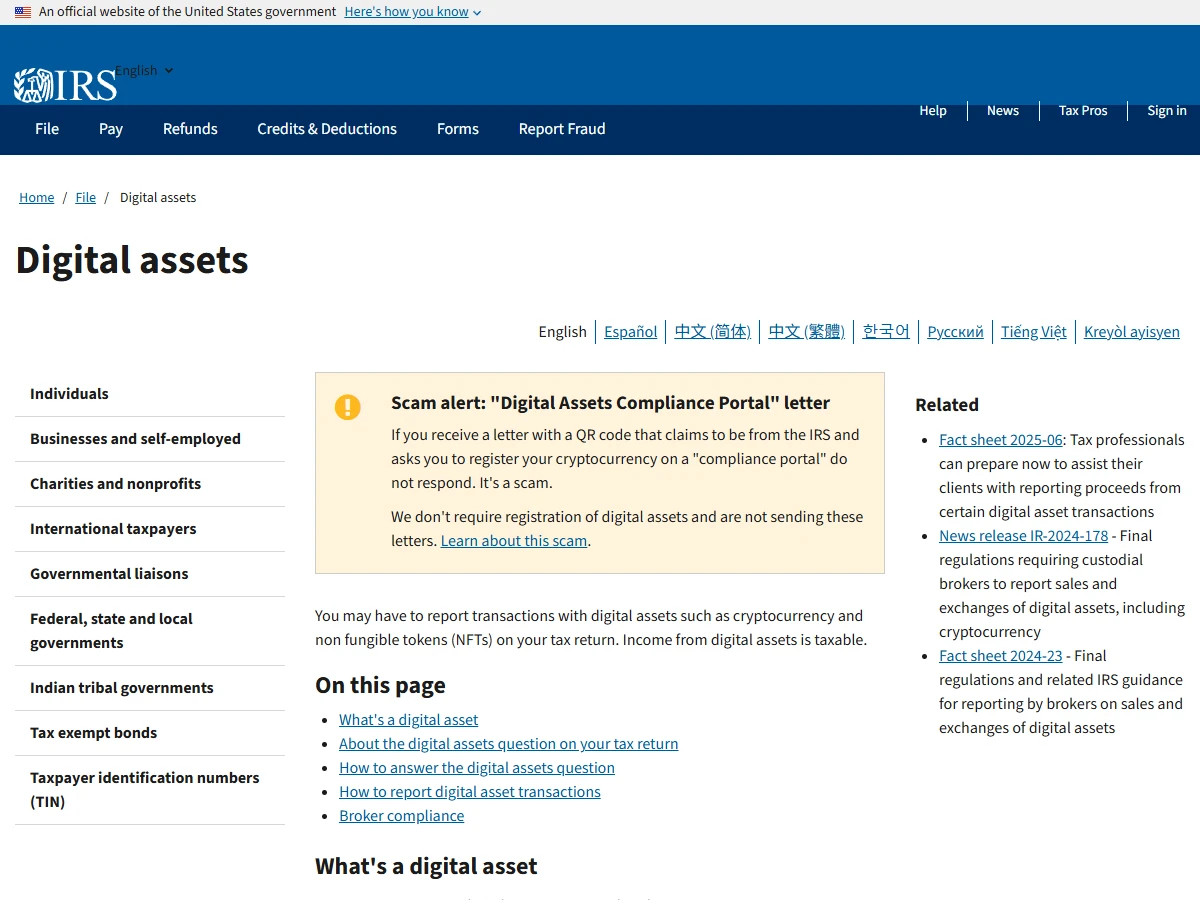
For sales through US brokers on or after 1 January 2025, the platform reports gross proceeds to the IRS on Form 1099-DA, and from 2026 it must also report cost basis on certain transactions. Stablecoin sales may be reported in aggregate. A dollar stablecoin trades close to $1, so the gain or loss is usually tiny, but it still has to be reported.
Elsewhere, some countries tax crypto gains as capital gains, some only when you convert back to fiat (France does not tax crypto-to-crypto swaps, for example), Germany exempts private sales after a year of holding, and some still have no clear rule. Wherever you are, keep the date, amount, price and order number of each trade; it makes the return much easier. For larger sums or complicated cases, ask a local tax professional.
Common questions
Sources and updates
- IRS: digital assets ↗
- Binance: personal account identity verification ↗
- Binance: spot fee and transaction overview ↗
- Binance: how to report a scam ↗
- Wise: receiving fees and limits ↗
- FATF: risk-based guidance for virtual assets and service providers ↗
- FBI IC3: cryptocurrency crime information ↗