Put $10,000 in a Hong Kong bank and deposit insurance covers you if the bank fails; put it in a US-dollar account at a Singapore bank and it does not. Leave it in Wise and you can send it on the same day; park it in a money market fund and you wait a trading day or two. Converting to dollars is the easy part. Where the money sits decides who pays you back if something fails, how fast you can reach it, and what a year of holding it costs.
Bank, wallet, broker and stablecoin compared
Start with the whole picture. The table shows typical cases; for any single provider, its own terms and fee schedule decide.
| Option | If the provider fails | Main costs | Getting money out | To open |
|---|---|---|---|---|
| Bank account abroad | Depends on where the bank is: $250,000 per depositor, per bank, per ownership category in the US; HK$800,000 in Hong Kong and NT$3 million in Taiwan, foreign currency included in both; Singapore covers Singapore dollars only | Wires often $15 to $50 each; monthly fees below a minimum balance | Wires take 1 to 5 business days | High: passport, proof of address, often a branch visit or opening deposit |
| Multi-currency wallet Wise, Revolut and others | Usually e-money in safeguarded accounts, not deposit insurance; in some regions a licensed bank provides it | A percentage fee on conversion, shown before you confirm | Same currency often same day; cross-border in a day or two | Low: sign up on a phone and upload ID |
| Brokerage cash Money market funds | SIPC if a US broker fails; the fund itself is not FDIC-insured and can lose value | The fund's expense ratio; some brokers charge account fees | Usually one or two trading days after a sale | Medium: a brokerage account; some brokers accept non-US residents |
| Stablecoins USDT, USDC | No deposit insurance; the price can briefly slip from $1 | Trading fees around 0.1%, a network fee to withdraw, a spread when you sell back | Minutes on-chain; cash depends on the cash-out route | Low: an exchange account plus identity checks |
Fees and timings are typical ranges, not any provider's quote.
Bank accounts abroad: the strongest protection, the pickiest gatekeeper
A bank deposit is the only one of the four that can carry deposit insurance, and whether it does depends on where the bank is, not on the currency you hold. Before keeping foreign currency at a bank, check whether the local scheme covers it; the rules vary a lot:
- United States: the FDIC covers up to $250,000 per depositor, per insured bank, per ownership category. Deposits at overseas branches of US banks are generally outside FDIC coverage.
- Hong Kong: since October 2024 the Deposit Protection Scheme pays up to HK$800,000 per depositor per bank, and US-dollar and other foreign-currency deposits are included, converted to Hong Kong dollars at payout.
- Taiwan: the Central Deposit Insurance Corporation covers up to NT$3 million per depositor per insured institution, New Taiwan dollar and foreign-currency deposits alike, with payouts made in New Taiwan dollars.
- Singapore: deposit insurance covers up to S$100,000 per depositor per member bank, but only for Singapore-dollar deposits, so US dollars held at a Singapore bank are not insured.
A foreign currency account at a bank where you live falls under the same rules; how to read its posted rates, what converting in and out costs and what breaking a time deposit early does are in keeping US dollars at your local bank.
The price of a bank account is the gatekeeping and the transfer cost. Opening one takes a passport and proof of address, and many banks want you in a branch or ask for an opening deposit. Each international wire costs something like $15 to $50, and an intermediary bank may take another slice on the way. It suits money that needs bank statements, is large, or will sit for years. Documents, fee arithmetic and how to test the whole route with a small transfer are in how to open an offshore dollar account.
Multi-currency wallets: quickest to open, usually not a deposit
With Wise, Revolut and similar services you sign up on a phone, upload ID and start using the account, and in many regions you also get US-dollar account details for receiving salary or invoices from American payers. When you convert, the fee and the amount you will receive appear before you confirm, which is far clearer than a bank counter.
What you need to check is what the balance legally is. Wise's UK entity, for example, is not a bank: customer money is not covered by the UK's FSCS deposit scheme and is instead kept apart from the company's own funds, mostly at large banks and in government bonds. Revolut serves the European Economic Area through its Lithuanian-licensed bank, where deposits are covered up to €100,000 under the Lithuanian scheme. The same brand can mean a different legal arrangement in each region, so look for the contracting entity in the terms.
A wallet suits wages paid in dollars, travel and frequent small conversions, less so a large sum left for years. Risk reviews occasionally freeze accounts, and the money is out of reach while they last. More detail is in can Wise and Revolut hold dollars.
Brokerage cash and money market funds: for money that can sit
If some dollars will not be needed for a year or two and you want interest on them, a brokerage account is a common home. Cash in the account and a money market fund are two different things.
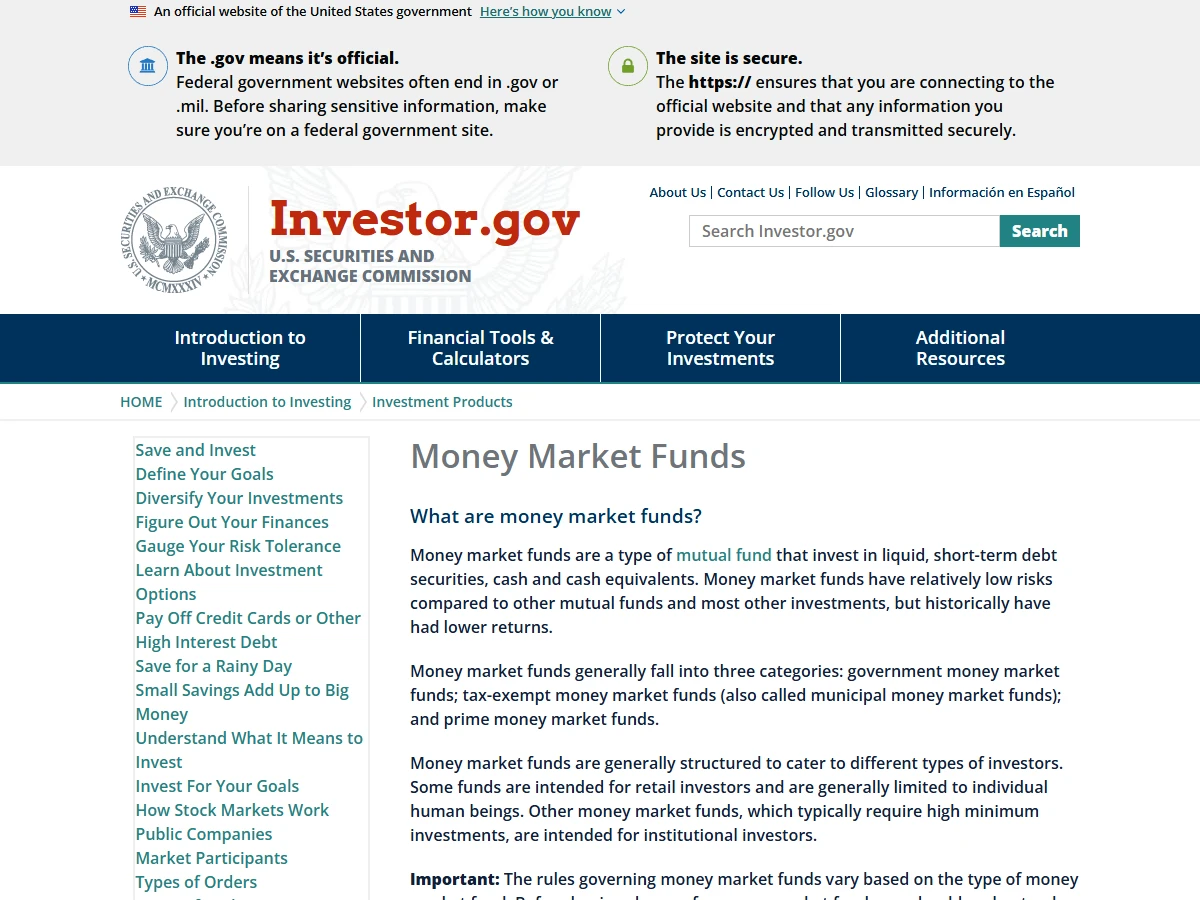
Many brokers automatically sweep idle cash into deposits at partner banks, at a rate the broker sets, which can be well below what a money market fund pays. A money market fund invests in short-term debt such as Treasury bills and commercial paper, and its yield follows short-term interest rates. Government money market funds keep at least 99.5% of assets in cash, government securities and repurchase agreements backed by them. A fund is not a deposit and is not FDIC-insured, so a loss is possible.
If the broker itself fails, US brokers carry SIPC protection of up to $500,000 per customer, of which up to $250,000 can be cash. SIPC restores assets missing when a broker fails; it does not cover market losses. After you sell a fund, the cash is available within one or two trading days. Whether a non-US resident can open an account, and how much tax is withheld on distributions, depends on the broker and your tax status; the W-8BEN, withholding, US estate tax and how to check the broker's entity are covered in money market fund or T-bills.
Stablecoins: always movable, nobody backstops them
USDT and USDC are the two most widely used dollar stablecoins. Each is priced one to one with the dollar and can sit in an exchange account or your own wallet and move at any hour. For people who cannot buy dollars easily through local banks, or who send money across borders often, they are the lowest barrier of the four.
They are issued and disclosed differently. USDC is issued by Circle, which publishes monthly reserve attestations by Deloitte and keeps most reserves in a government money market fund managed by BlackRock. USDT is issued by Tether, which publishes quarterly attestations by BDO. An attestation is not a full audit; it confirms the reserve figures on a particular day.
The biggest weakness is that no deposit insurance applies. In March 2023 Circle disclosed about $3.3 billion of reserves at the failed Silicon Valley Bank, and USDC fell to around $0.87 until regulators said all SVB deposits would be protected. Issuers can also freeze coins at specific addresses. How to spot these risks early is covered in stablecoin risks.
To start with stablecoins, the first step is an exchange account; the Binance sign-up guide shows with screenshots where the invite code goes and how to pass the ID check. Buying, holding and moving them are explained in holding and transferring USDT or USDC.
What $10,000 costs to hold for a year
This is a hypothetical example to show where costs land, not any provider's quote. Assume one deposit and one withdrawal of $10,000 during the year.
| Option | Money in | Holding for a year | Money out | Total, roughly |
|---|---|---|---|---|
| Bank account abroad | Receiving fee $15 | Balance above minimum, no monthly fee: $0 | Outgoing wire $25, intermediary $15 | $55 |
| Multi-currency wallet | Same-currency receipt: $0 | $0 | Conversion to local currency at 0.5%: $50 | $50 |
| Money market fund | $0 | Expense ratio of 0.1%: $10 | Wire out $25 | $35, before interest earned |
| Stablecoins | Trading fee 0.1%: $10 | $0 | Selling at 0.1% plus a network fee of about $1: $11 | $21, plus buy and sell spreads |
Every figure in the table is an assumption. In practice the gap comes from two places: the spread hidden in the exchange rate, and the cost of your local cash-out route, where a P2P sale can cost more than the trading fee. Compare with the same amount and look at what you actually receive; the spread calculator works it out from your own numbers.
If your country has currency controls
If your country limits how much foreign currency individuals can buy, or regulates conversion and moving money abroad, start with the rules themselves: how much you may convert each year, whether local banks offer foreign-currency accounts, whether you can withdraw those deposits as cash, and whether holding and using crypto is legal. Many countries allow foreign-currency deposit accounts at local banks, and that is often the safest first step.
Stay away from informal exchange and underground money brokers; the risk of being cheated or having funds frozen is high, and you may break local law. Stablecoins are legal in some countries and restricted or banned in others, so local rules decide. The fuller approach is in holding dollars under currency controls.
Splitting money by purpose
Few people end up with just one option. Common combinations look like this:
- Paid in dollars and converting some to spend: receive into a multi-currency wallet, move larger sums on to a bank account, and keep only a few months of spending in the wallet.
- An emergency fund for the family: keep it where you can reach it the same day, such as a foreign-currency account at a local bank, not somewhere that depends on a wire or a cash-out route.
- Money you will not need for three to five years and want earning dollar interest: if you can open a brokerage account, a money market fund is common; if not, a US-dollar term deposit at an insured bank.
If you are still unsure, the three-question picker asks about timing, bank records and what matters most, and points you to the guide to read first.
Common questions
Sources
- FDIC: Deposit Insurance FAQs
- Hong Kong Deposit Protection Board: coverage
- Singapore Deposit Insurance Corporation: FAQs
- Taiwan Central Deposit Insurance Corporation: FAQs
- Investor.gov: Money Market Funds
- SIPC: What SIPC protects