A usable offshore dollar account is more than a submitted application. You need written support for the bank entity taking the deposit, the bank's acceptance of your status and documents, the full cost of moving money in and out, and whether the money can return along the route you will need.
What the account is for
Start with the job the account must do: statements, a balance certificate, receipt of a particular payment, or routine cross-border transfers. For proof of funds, ask the recipient which format and date range it accepts. Without that use case, a minimum balance, fee or delay has no useful context.
Create one application record with four fields: deposit-taking entity and booking branch; eligibility and documents; full initial and ongoing cost; and expected times for receipt, availability and return. Attach the bank's terms, fee schedule or written reply to each field. Other customers' experiences can suggest questions, but they do not establish how this bank will treat your application.
“Dollar account” can mean four different things
A dollar account, a USD account and an offshore dollar account are often used interchangeably, yet they differ a lot in how hard they are to open and how they are protected:
| Type | What it is | Who can open one | Watch out for |
|---|---|---|---|
| Foreign-currency account at a local bank | A US-dollar deposit account at a bank in your own country, often called a domiciliary or FCY account | Residents, where local rules allow | Local rules decide cash withdrawals and transfers out |
| Account at a bank in a financial centre | A bank account in Hong Kong, Singapore or similar, holding dollars | Non-residents can often apply, usually with a branch visit and an opening deposit | Deposit insurance follows the local scheme; Singapore does not insure US-dollar deposits |
| Account at a US bank | A checking or savings account at a bank in the United States | Hard for non-residents; most banks want you in person or a US address | Eligible deposits are FDIC-insured |
| Dollar account details from a payment company | Services such as Wise give you US-dollar account details for receiving payments | Sign up on a phone, if the service covers your country | Usually not a bank deposit; protection works differently |
This guide covers the second and third types: dollar accounts at banks abroad. The fourth is in can Wise and Revolut hold dollars, and all four ways of holding dollars are compared in where to hold US dollars.
How a dollar transfer actually travels
A bank outside the US does not keep a pile of dollar bills behind your balance. It holds its own dollar account at a large US bank, known as a correspondent bank. When you wire dollars out, your bank usually instructs its US correspondent to pay the recipient bank's correspondent, and transfers between banks inside the US run over systems such as the Federal Reserve's Fedwire.
Each extra bank in that chain can take a fee. When a recipient gets less than you sent, an intermediary deduction is the usual reason; step 3 below counts that cost separately.
Hong Kong is an exception. It runs its own US-dollar payment system, USD CHATS, which started in 2000 with HSBC as the settlement institution, so dollar transfers between local banks can settle in real time during Asian business hours without going through the US.
That is why someone paying you in dollars may need more than your name, account number and the bank's SWIFT code: some banks also ask for the intermediary bank's name and SWIFT code. These are on the bank's incoming-payment instructions, so copy them from that page rather than from memory. Where the details mention “USD clearing”, that means the account the bank uses at its US correspondent to settle dollars.
Step 1: verify the bank entity and deposit cover
Before applying for an offshore dollar account, open the account agreement and find the full legal name of the company accepting your deposit, the country or territory of the booking branch, and the product name. A banking brand can operate through different entities in different places. A screen showing a dollar balance is not, by itself, evidence that you hold a bank deposit.
Look up that legal entity in the local regulator’s or deposit insurer’s register. Check that its name, website and operating status match. Then check the product documents for deposit eligibility, the name of the protection scheme and the way its limit is calculated. “We are regulated” does not answer whether this deposit is insured. Ask the bank to point to the applicable product terms and coverage explanation.
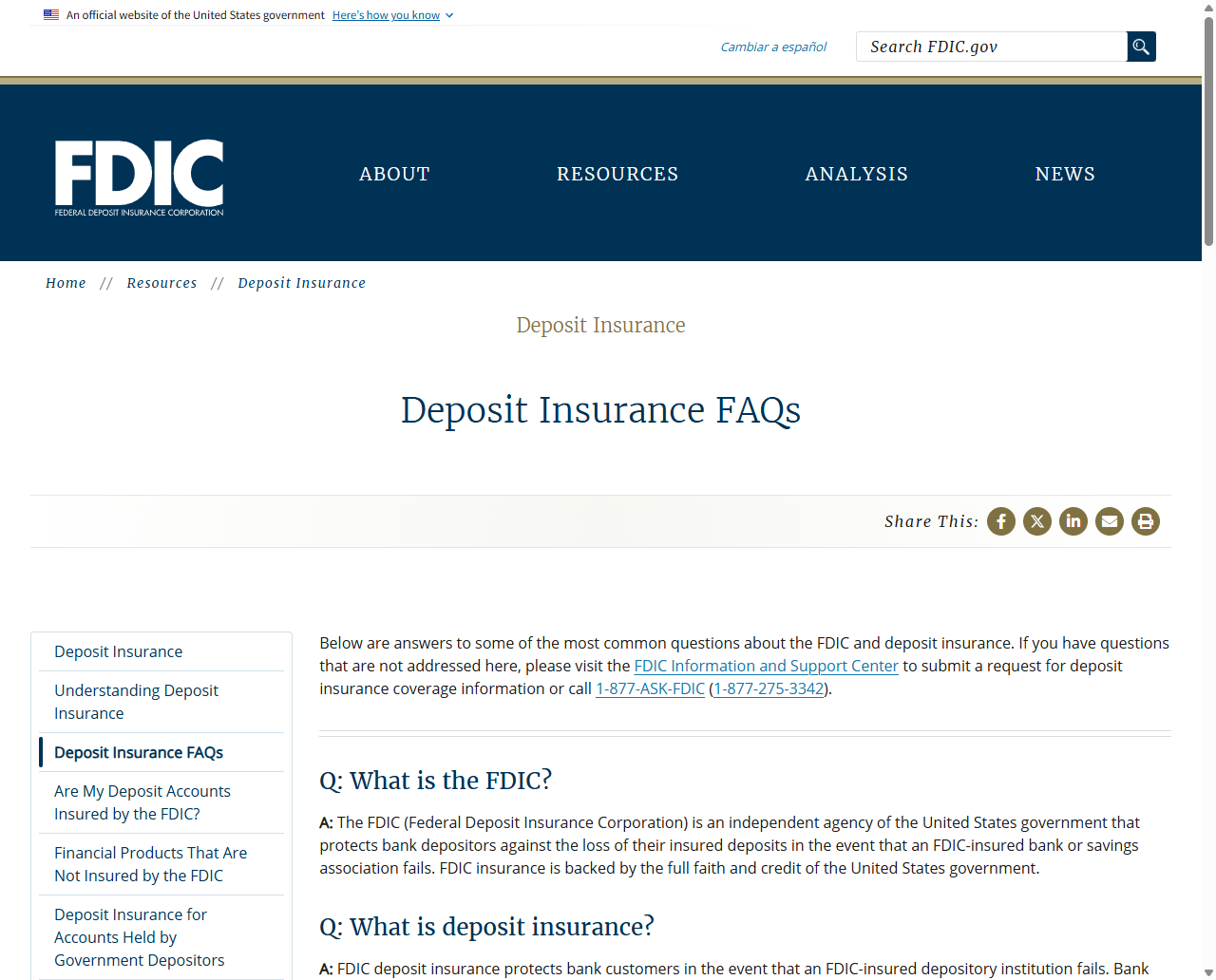
For example, the US FDIC’s deposit insurance FAQs give a standard limit of $250,000 per depositor, per insured bank, per ownership category. Opening another account does not automatically provide another limit: eligible deposits at the same bank in the same ownership category are added together. Mutual funds, stocks and bonds sold by a bank do not become insured deposits just because you bought them there.
The location matters too. The FDIC’s Deposit Insurance Basics explains that deposits at overseas branches of US banks are generally outside FDIC coverage. This is a US example. For an account elsewhere, check the local scheme’s eligibility rules, treatment of foreign currency, limits and aggregation rules.
Before funding the account, complete this sentence and save the supporting documents: “My deposit is accepted by ___, booked at its ___ branch, held in the ___ product and covered by ___, subject to these limits and aggregation rules: ___.” If you cannot fill in a part, get a written answer from the bank before considering a larger transfer.
Step 2: build the document pack to this bank's rules
Open the target bank's checklist and confirm which evidence it accepts from an applicant in your circumstances:
- Proof of identity: a passport or a locally accepted ID document
- Proof of address: a utility bill, lease or bank statement showing where you live
- Sometimes an in-person check: some banks ask you to appear at a counter, or at a named branch, to verify your identity
- Sometimes a minimum balance: opening or keeping the account needs an opening sum, and falling short may block the account or trigger a fee
- Sometimes a source-of-funds explanation: large inflows may need you to explain where the money came from
Check what this bank will actually accept
Proof of address is a common source of repeat requests. Confirm which documents the bank accepts, how recently they must have been issued, whether electronic statements are allowed, and whether translation or certification is required. A lease or bill may prove where you live without meeting that bank’s document rules. Names and addresses should also agree with the application; explain discrepancies as requested instead of altering original documents.
If the application asks for tax residence, a tax identification number or source-of-funds evidence, provide information that reflects your circumstances. For salary, prepare the payslips and matching credits the bank asks for; for an asset sale, the requested contract and receipt records. The aim is to explain the origin and movement of this money, not to hand over every private document you own.
Before travelling to a branch or paying for translations, confirm that the bank accepts your residency status, whether the application can be completed remotely, and whether the opening deposit differs from the balance needed to waive maintenance fees. Save its document list and written replies. Submit identity documents only through verified bank channels, then use the application reference to follow up on missing items. An application acknowledgement is not confirmation that an account has been approved and can receive funds.
Step 3: calculate the full transfer and holding cost
Getting the account open is only the start. The real cost of holding sits in a few day-to-day fees. For an offshore dollar account, the three to watch most are below.
| Fee | When it hits | Who charges it | How to keep it down |
|---|---|---|---|
| Outgoing wire fee | On each international wire you send | Your sending bank | Batch larger sums, send fewer wires |
| Intermediary or correspondent fee | When funds pass through a relay bank | The correspondent bank in between | Ask up front who pays and what route |
| Account maintenance fee | Monthly or yearly | The bank you opened with | Check whether a balance waives it |
The specific amount of each fee is whatever the bank's fee table shows at the time.
For a one-year estimate, multiply the monthly charge by the number of months it will actually apply, then add the outgoing, receiving and intermediary charges for the transfers you expect to make. List one-off opening, translation or travel costs separately. Convert actual charges to one currency using the rate you record, and list the minimum balance separately rather than counting principal as a fee.
Of the three, the intermediary fee surprises people most. A cross-border wire often does not go straight from your bank to the other bank; it passes through one or more correspondent banks, and each hop can take a cut. The result is that the other side receives less than you sent, and you may not have known in advance who took it or how much. Before you send, it is best to confirm who bears the fees and what route the money takes.
Wire and maintenance fees are relatively transparent, but do not ignore them either. The maintenance fee looks small, yet over a long hold it adds up to a real number; some banks waive it if you keep a certain balance, which is worth confirming when you open. To tally these fees together with the spread you pay on conversion, see this piece: How the spread and fees add up, and how to back out what got eaten.
Copy the official fee schedule into the same record
To judge whether an offshore dollar account is expensive, skip the marketing and find the fee table on the bank's own site. It usually lives under a section called Fees, Pricing or Schedule of Fees. Once it opens, focus on these three fields:
wire transfer fee: the wire fee. Check whether it applies to outgoing wires, incoming wires, or both endsmaintenance fee: the account maintenance fee. Check whether it is monthly or yearly, and whether a balance waives itminimum balance: the minimum balance requirement. Check what happens if you fall short, a fee or no account at all
Also look for correspondent or intermediary bank charges, and whether larger transfers need additional documents. A minimum balance is not itself a fee, but it ties up funds and may determine whether maintenance charges are waived. Record the required balance separately from actual charges so that you do not count principal as a fee. Use the bank’s current schedule for the figures.
Reconcile a $5,000 transfer from both ends
Take a hypothetical transfer, not a quote from any bank: you send $5,000 and pay a separate $25 sending fee. An intermediary deducts $15 and the receiving bank deducts another $10. No currency conversion takes place.
| What you check | Amount |
|---|---|
| Total debit from your account | $5,000 + $25 = $5,025 |
| Funds available at the other end | $5,000 − $15 − $10 = $4,975 |
| Total cost between the two ends | $5,025 − $4,975 = $50 |
As a share of your total outlay, the cost is $50 ÷ $5,025 × 100%, or about 1.00%. Looking only at the $25 sending fee misses half the cost. If conversion is involved, first express both ends in the same currency and record the exchange rate and time used. Do not add a spread again if it is already included in the gap between the actual debit and credit.
Before sending, record the transfer amount, separately charged fees, exchange rate, known third-party deductions, expected net receipt and expected availability date together. The US CFPB’s guidance on sending money abroad also identifies fees, rates and the recipient’s amount as important disclosure information. Its consumer rights apply to transfers covered by the US rules it describes; they are not universal rules for every country or transfer. Compare banks using the same amount and currencies, with attention to the money available at the end and how long it takes.
Step 4: test the first deposit and return route
Record when funds should become available
Check the expected time for the route you will actually use. Sending-bank cut-off times, business days at both ends, holidays, intermediaries and manual reviews can affect when the money becomes available. Ask for the usual processing time and which bank should handle a query if it is exceeded. A friend’s fast transfer is not a promise about yours.
If the money has to cross borders before you can spend it, leave room for transfer delays. Keep money needed for a near-term payment in an account or payment route you have already confirmed you can use. The question is how quickly this particular route makes funds available, rather than whether every bank account is inherently slow.
Once the account is approved, use its receiving instructions to check the beneficiary name, account number, bank identifier, currency, payment purpose and fee arrangement. Do not copy another customer’s bank details from a forum. Start with an amount whose fees and possible loss you can afford, on the route you actually intend to use. It must also meet the bank’s minimum transfer requirement.
Save the sending confirmation and bank reference. At the receiving end, check the available balance, not just a “processing” notification: is the currency correct, how much was deducted, does the transfer appear on a statement, and are the funds still restricted? Take records from both ends to the bank if a deduction is unexplained. The difference alone does not tell you which intermediary charged it.
If you will eventually need to send money back to the original account, return part of this small deposit under the bank’s rules. That reveals the return fees and restrictions, and whether the original bank can receive the payment. A successful incoming transfer has not yet tested the whole route you need.
Keep the fee schedule version, both statements, bank references and written support replies. A small test establishes that this transfer worked; a larger one may still require documents, be delayed or be rejected. If the beneficiary is wrong, the funds remain unavailable, or someone asks you to move money to a personal account to fix a problem, stop adding funds and contact the bank through its published channels.
Decide from the results
Compare the evidence with the original purpose. Does the account produce the record you need? Can you identify the entity and coverage? Can you meet the document and in-person requirements? What will one year of maintenance and one round trip cost? Did the test make funds available before your real deadline? The account fits this use only when those answers work together.
Do not replace that record with “bank accounts are safe” or “the wire fee is the whole cost.” Deposit cover has entity, product, limit and location conditions. A balance at one bank is not money already available at the other end.
Check local rules separately. Permission to open the account, limits and reporting duties depend on your location and circumstances. This guide draws no country-specific conclusion; use official rules and suitable local advice for a larger or complex case.
Suspicious charges and account security
Do not give an incoming caller your banking password, an SMS verification code or other account secrets, and do not follow instructions to move funds to a supposed “safe account.” Hang up and find the bank’s contact details on its official website. For fake support and phishing sites, see scams and account safety.
Sources and updates
- FDIC: Deposit Insurance FAQs ↗
- FDIC: Deposit Insurance Basics and deposits outside the United States ↗
- US CFPB: money-transfer disclosures and resolving problems ↗
- Federal Reserve Financial Services: Fedwire Funds Service ↗
- HKMA: assessment of the US dollar CHATS payment system ↗