A $5,000 balance on the Wise home screen looks no different from money in a bank. The difference shows only if the company fails. Bank depositors are paid by deposit insurance up to a limit. When an e-money firm like Wise fails, customers are repaid from the money it had to keep separate, and the UK's Financial Conduct Authority says you should get most of it back, though it may take time and may not be the full amount.
Yes, but it is usually not a deposit
Wise and Revolut both let you hold a US dollar balance and use it to receive, pay and convert. In most regions, though, that balance is legally e-money, and the company issuing it is not a bank. Day to day you cannot tell the two apart; the table shows where they differ.
| Question | Bank deposit | E-money balance |
|---|---|---|
| What the firm may do with your money | Lend it out | Not lend it; keep it apart from company money |
| If the firm fails | Deposit insurance, e.g. FDIC up to $250,000 per depositor, per bank, per ownership category | Repaid from the safeguarded customer funds |
| How much, how fast | In full up to the limit, usually quickly | Most of it, possibly after a wait and minus insolvency costs |
| Suits | Larger sums left for years | Everyday payments, a few months of spending |
Which column Wise or Revolut falls into depends on your region and the company you signed with. The two are covered separately below.
Where Wise keeps customer money
Wise explains this in its help centre. Banks lend out deposits, which is why governments make them join deposit insurance schemes such as the UK's FSCS. Wise says it does not lend out customer money, so instead of deposit insurance it safeguards it: customer funds are kept apart from Wise's own money and available when you need them. Its regulatory obligation is to hold all of that money in cash, in secure liquid assets, or insured by a comparable guarantee.
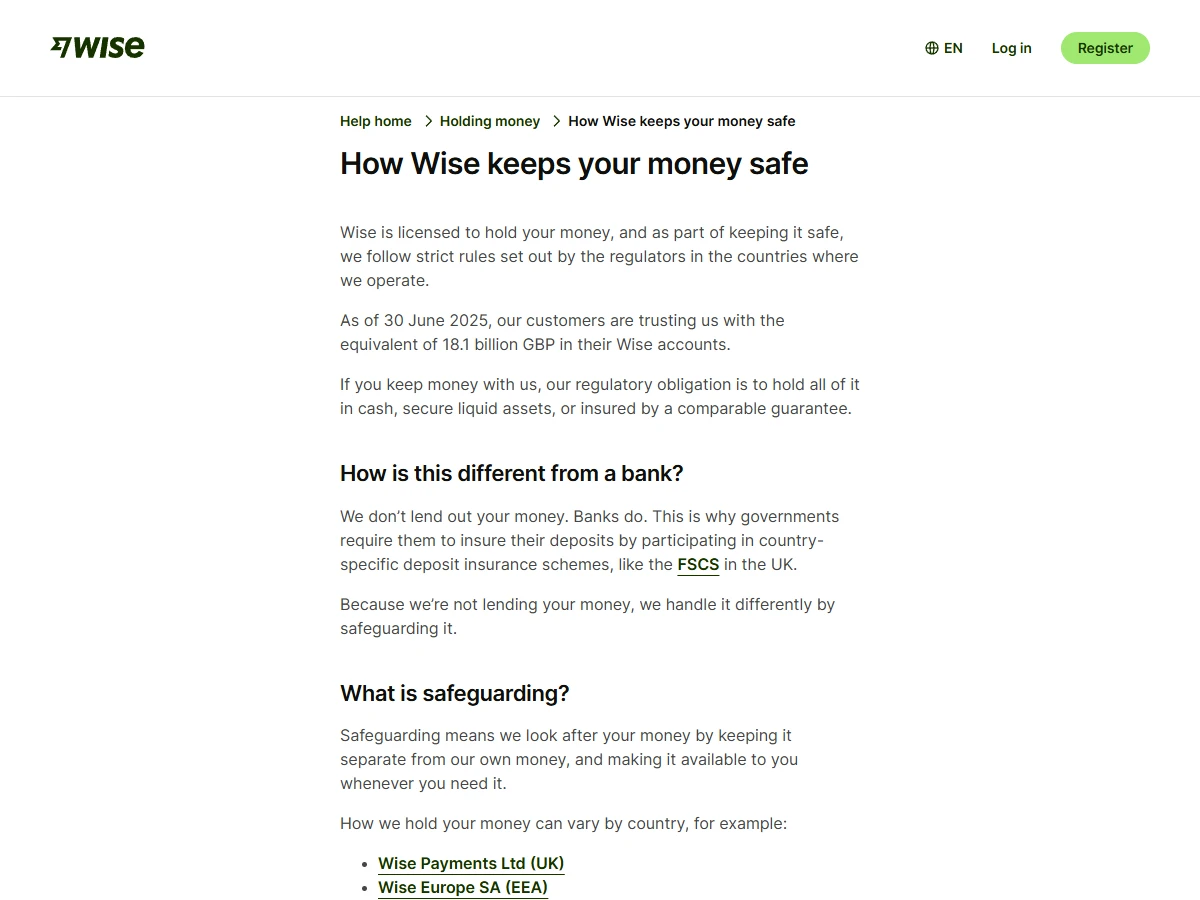
As for where the money sits, Wise says most of it is in secure liquid assets such as EU, UK and US government bonds, and in money market funds from 1 April 2024. The average duration of the bonds is under six months, and most have three months or less left to run.
What this means for you is spelled out on the FCA's consumer page: if a non-bank payment provider goes out of business, your money is not protected by the FSCS. Because of safeguarding you should get most of it back, but it may take time and may not be the full amount, since the administrator or liquidator can take some costs from it.
Different Wise companies serve different regions: Wise Payments Ltd in the UK, Wise Europe SA in the EEA, and separate arrangements in the US, Canada, Japan, Brazil and elsewhere. Your account terms name the one you signed with. And if you switch on the Interest feature, that part of the balance becomes money market fund units, which Wise marks as capital at risk; it is no longer an ordinary balance.
Revolut depends on which company you signed with
In the EEA, Revolut's service comes from Revolut Bank UAB, a bank licensed in Lithuania. Money held there is a bank deposit, covered by Lithuania's deposit insurance up to €100,000 per person. Dollar balances count, and any payout is made in euros.
In the UK, Revolut received a banking licence with restrictions in July 2024. Which company holds your account today, and whether the balance counts as a deposit or as e-money, is written in the account details and terms in the app. Other countries may be served by yet another company under different rules.
The test is the same for both brands: find the full name of the company in your terms, then check whether it is a bank or an e-money institution. The same logo can sit on very different legal arrangements.
USD account details: who can pay you
In many regions Wise gives you a set of US account details, an account number and a routing number, so an American employer, client or platform can pay you as if paying a local US account. People who work for US companies from abroad, or sell on US marketplaces, often open the account for exactly this.
On fees, Wise says receiving USD by ACH (ordinary US domestic transfers, the kind used for direct deposit of wages) is free. Receiving domestic US wires and international Swift payments carries a fee, set by the price list for your region. If the payer can use ACH, ask for ACH rather than a wire.
The details are registered in your name and are meant for money paid to you. Using them to collect payments for someone else, or lending them to a friend, is one of the most common reasons accounts get frozen.
Conversion cost: compare what arrives
Wise converts at the mid-market rate and lists its fee separately, so the screen shows the fee and the amount you will receive before you confirm. Revolut gives a free conversion allowance that depends on your plan; going over it, or converting at the weekend, adds a fee described in its fee terms. Both show the amount received on the confirmation screen, and these are the numbers to write down:
| Write down | Where to find it | Why |
|---|---|---|
| Local currency paid | Order confirmation | Only the same amount can be compared |
| Dollars received | Order confirmation | Already includes the spread and the fee |
| Receiving fee | Price list | Wires and Swift payments may cost extra |
| Cost to send it back home | Price list, withdrawal screen | In and out together is the full cost |
A no-fee label proves little when a markup can sit inside the rate. How the spread and fees add up is covered in how spreads and fees add up, and you can try your own numbers in the FX spread calculator.
Why accounts get frozen
Multi-currency wallets run anti-money-laundering checks just as banks do, and most of the screening is automated, so it triggers mechanically. When an account is paused or asked for documents, it is usually for one of these reasons:
- Sign-up details that do not match your ID or address, or someone else's details
- Large amounts moving through a brand-new account, out of line with the job or purpose you gave
- Money from unknown third parties, especially money that leaves again straight away
- Logging in from a country or region the service does not cover
- Receiving or paying on someone else's behalf
While a review is open the balance is usually locked. When asked for documents, reply inside the app. Expect three requests: proof of where the money came from (payslips, contracts, invoices or bank statements), who paid you, and what the money is for. Complete, consistent answers get cleared fastest.
Freeze notices and document requests arrive only in the app and at the email you registered with. Anyone who messages or calls offering to unfreeze the account for a fee is running a scam; the common scripts are in Scams and account safety.
Get money back out before adding more
When you verify your identity, enter your name exactly as it appears on your ID and use a proof of address that matches the address you typed; a mismatch in either is an easy way to get sent back. Once the account is open, send a small amount from a local account in your own name, convert it, and send part of it back. The confirmation screen shows what the way in costs. What the way out costs, and how long it takes, you only find out by doing it.
Screenshot the company name in your terms, the price list and those first transactions while you are at it. If you are asked for documents later, they are already on file.
How much to keep there
A multi-currency wallet suits money that moves: foreign-currency wages, travel, monthly conversions. A large sum you will not touch for years is better off in a bank account with deposit insurance, for the reason in the first table: if an e-money firm fails, you should get most of your money back, but not necessarily all of it, and not necessarily soon.
A common setup is to keep two or three months of spending in the wallet and move the rest to a bank dollar account as it builds up. What an offshore bank account needs and how to open one is in how to open a US dollar account abroad; the four options side by side are in where to hold US dollars.
Common questions
Sources
- Wise: How Wise keeps your money safe
- Wise: fees and limits for receiving money
- FCA: using payment service providers
- FCA: safeguarding requirements for payment and e-money firms