Most of the time a stablecoin sits quietly at $1 and nobody gives it a second thought. Its risks tend to arrive together: a reserve problem pulls the price down, a platform pauses withdrawals and the money is stuck, or a transfer goes out on the wrong network and never arrives.
The main stablecoin risks at a glance
| Risk | What it looks like | When it happened | What you can check |
|---|---|---|---|
| Depeg | The price falls below $1 when confidence in reserves or redemption wobbles | In March 2023 Circle disclosed about $3.3 billion of reserves at the failed Silicon Valley Bank, and USDC fell to around $0.87 | Prices on several exchanges; the issuer's notices |
| Reserves too thin or in the wrong place | Reserves are too small, slow to sell, or concentrated somewhere that fails | The same episode: part of the reserves was stuck in one failed bank | Reserve reports: which assets, held where, as of which date |
| Algorithmic failure | Coins that rely on an algorithm rather than cash reserves can spiral down under selling | In May 2022 the algorithmic stablecoin TerraUSD (UST) lost its peg and most of its value within days | Whether the coin has cash-like reserves at all |
| Redemption limits | Ordinary holders usually cannot redeem with the issuer and must sell on a market | Direct redemption is typically open only to verified or institutional customers, with high minimums | The issuer's terms: who can redeem, the minimum, the fee |
| Platform and custody | An exchange freezes withdrawals, fails or is hacked | In November 2022 FTX halted withdrawals and filed for bankruptcy | Who holds the keys; whether withdrawals are running |
| Freezes and blacklists | The issuer can freeze coins at specific addresses | The USDT and USDC contracts both include a freeze function, typically used at the request of law enforcement | Refuse coins of unknown origin; ask why before assuming the worst |
| Operational and technical mistakes | Wrong network, wrong address, or a bug in a contract or bridge | Coins sent on a network the recipient does not support may never be credited | Network, address and contract; send a small test first |
| Regulatory change | Rules decide who may issue or sell a stablecoin in a region, and non-compliant coins get delisted | The EU's MiCA stablecoin rules have applied since 30 June 2024, after which several exchanges removed unauthorised stablecoins for users in the European Economic Area | Whether the coin and the platform are permitted where you live |
These risks rarely arrive all at once. A coin can hold its price with ample reserves while your exchange pauses withdrawals, or the platform can run normally while the price dips on a reserve headline. When something goes wrong, the first job is to find which link in the chain has failed.
A withdrawal is stuck: find where the money stopped
| What you see | Save first | Go to |
|---|---|---|
| A quote away from $1 | Time, venue, pair, network and contract | Prices on other exchanges and the issuer's notices |
| “Processing” with no transaction hash | The full message, request time, reference and network | The sending platform's support |
| A hash, but nothing credited | Hash, amount, address, network and contract | The on-chain status, then the recipient's support |
No transaction hash means the money is still inside the platform, so only its support team, reached through the help section in the app, can tell you where the request stands or whether documents are needed; searching the receiving address on a block explorer will show nothing. If there is a hash but the other side has not credited it, open the transaction, confirm it succeeded and that the network and contract match, then give the hash to the recipient. For coins sent on the wrong network, whether recovery is possible and what it costs is the recipient's call.
Until the problem is clear, do not send a bigger amount “to test,” and ignore anyone who offers to recover funds for a deposit or asks for your seed phrase. Normal network fees are listed on the platform's fee page; an “unlock fee” sent to a personal address through a private chat is a scam.
What a price below $1 does and does not tell you
A brief move away from $1 does not necessarily mean the issuer cannot pay; thin liquidity on one platform can produce an odd quote. Equally, a price back at $1 does not prove every holder can redeem at face value. When you see a gap, compare several exchanges, look for a formal notice from the issuer, and check the date of the latest reserve report.
Reserve-backed coins and algorithmic coins carry very different levels of risk. For the first, the question is usually where the reserves sit and how fast they can be sold; the second can lose its peg completely under heavy selling, as TerraUSD did in 2022. When something is described as “algorithmically stable” or as a stablecoin paying high yields, ask whether there are actually cash-like assets behind it.
How past depegs ended
When a depeg hits, what you want to know is how far the price will fall and how long it will stay down. Past episodes ended very differently, and the difference came down to whether there were redeemable assets behind the coin:
| When | Coin | Low | What happened next |
|---|---|---|---|
| May 2022 | TerraUSD (UST) | Lost most of its value within days | Never recovered; the project collapsed |
| May 12, 2022 | USDT | About $0.95 on some exchanges | Back near $1 the same day; more than $10 billion was redeemed over the next two weeks or so |
| March 11, 2023 | USDC | About $0.87 | Back to $1 within days after US regulators said on March 12 that all SVB deposits would be protected |
| April 2, 2025 | FDUSD | About $0.87 | The issuer denied insolvency and processed redemptions; the price was back near $1 within days |
For reserve-backed coins, the fall was mostly panic and a rush to redeem, and as long as the issuer kept paying out at $1 the price came back. A coin like UST with no cash reserves did not come back at all. Either way, in the hours or days before the price recovers, anyone who needs the money has to sell at a discount.
Trouble does not always show up in the price. On October 15, 2025, Paxos, the issuer of PayPal's PYUSD stablecoin, mistakenly minted 300 trillion PYUSD during an internal transfer and burned it within about half an hour, calling it an internal technical error and saying customer funds were safe. Nobody lost money, but it showed that an issuer's power to mint is a risk in its own right: one wrong parameter and an astronomical sum appears on-chain.
Reading reserve reports and redemption terms
When a page says reserves fully back the token, open the report itself: who prepared it, what date the figures describe, and which assets and liabilities were examined. An attestation confirms reserve balances on one day. It is not a full audit, and it says nothing about every day that followed.
In the redemption terms, look first for who is allowed to redeem. Most issuers open direct redemption only to verified customers and larger amounts. If the only way you can get out is to sell on an exchange, your real exit is that exchange's price and withdrawal process, not the issuer's promise. Write down the route you can actually take, for example “wallet, then an exchange supporting the same network, then a sale for local currency, then a withdrawal to my bank account,” and check each step. The steps are in how to turn stablecoins back into cash.
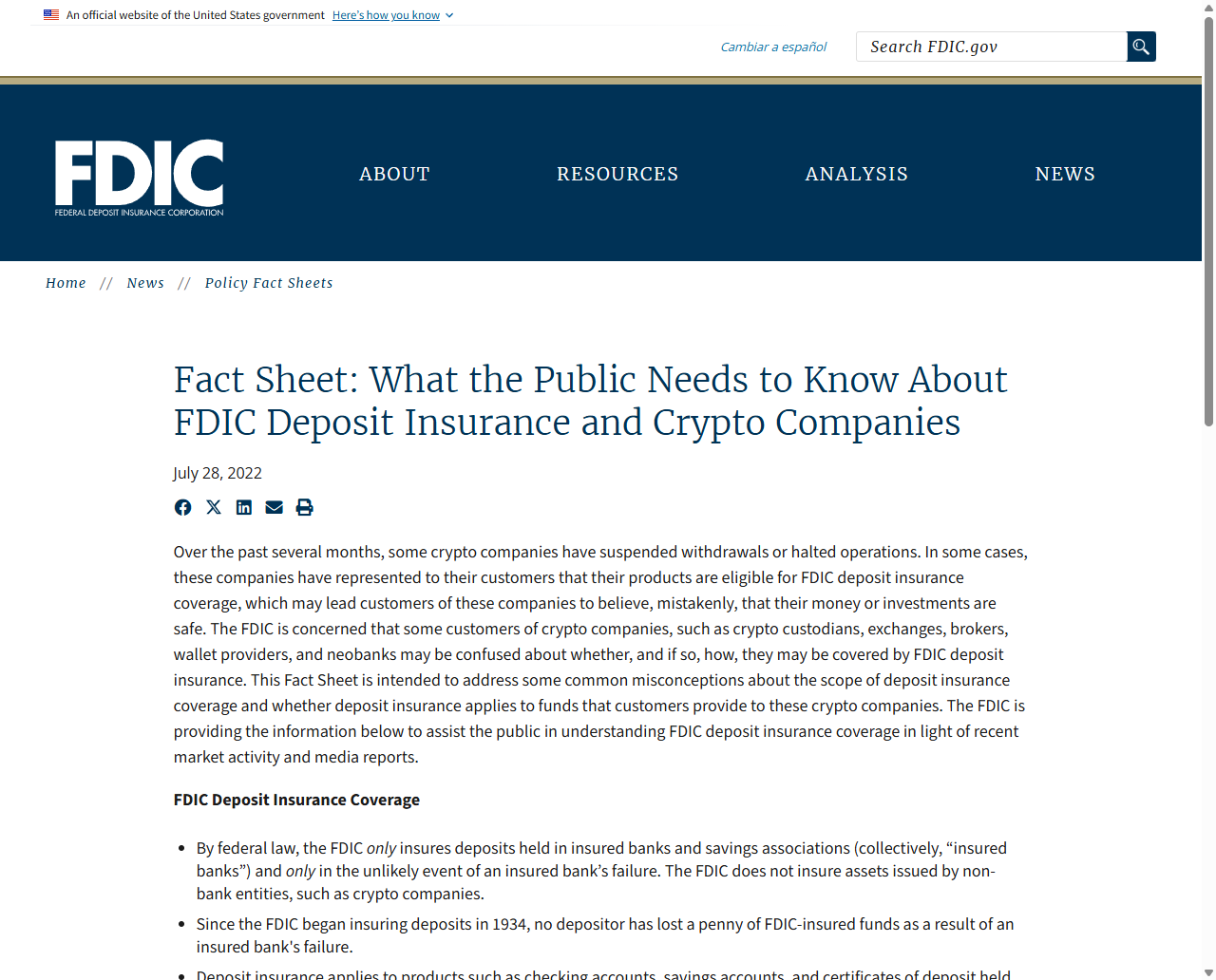
One point is often misunderstood: reserves held at an insured bank do not make your coins an insured deposit. The FDIC states plainly that deposit insurance protects eligible deposits at insured banks. It does not cover crypto assets, and it does not pay out when an exchange, custodian or wallet provider fails.
When the exchange fails, or you make a mistake
When FTX halted withdrawals in 2022, many users' stablecoins were trapped on the platform. At any exchange, a risk review, a business failure, a hack or a technical outage can keep you from your money when you need it most. Having the app on your phone does not mean the coins are yours to move; what matters is who holds the private keys.
Holding the keys yourself moves the risk onto you. Lose the seed phrase, approve a phishing request or send to the wrong address, and nobody can get the money back. Nor does self-custody stop an issuer from freezing coins at an address. For fake support agents and phishing, see scams and account safety.
Spreading coins across several places limits the damage if one platform fails, but every extra place adds keys and rules to manage. Do not add a service you do not yet understand just to spread the risk.
Regulatory risk: the rules can change while you hold
Attitudes to stablecoins differ widely between jurisdictions, and they keep changing. Under the EU's MiCA regulation, single-currency stablecoins offered in the EU may be issued only by authorised banks or electronic money institutions, with those rules applying from 30 June 2024; the European Securities and Markets Authority then told trading platforms to restrict unauthorised stablecoins by the end of the first quarter of 2025, and several platforms delisted some stablecoins for users in the European Economic Area. In the United States, the GENIUS Act, signed on 18 July 2025, set up a federal framework for payment stablecoins.
For a holder, the practical effect is that a coin can suddenly stop trading on your platform, or become sell-only. Before holding, check its status where you live. If local rules clearly restrict or ban individual use, do not look for someone to help you get around them; that is a bigger risk in itself. This site does not reach compliance conclusions for any country or region.
Common questions
Sources
- FDIC: deposit insurance and crypto companies
- CNBC: USDC breaks its dollar peg over SVB exposure
- European Banking Authority: asset-referenced and e-money tokens under MiCA
- ESMA: statement on stablecoins
- Congressional Research Service: overview of the GENIUS Act
- CNBC: USDT briefly drops below its $1 peg (May 2022)
- CNBC: USDT withdrawals top $10 billion
- Cointelegraph: FDUSD depegs after insolvency claims (April 2025)
- The Block: Paxos mistakenly mints $300 trillion PYUSD