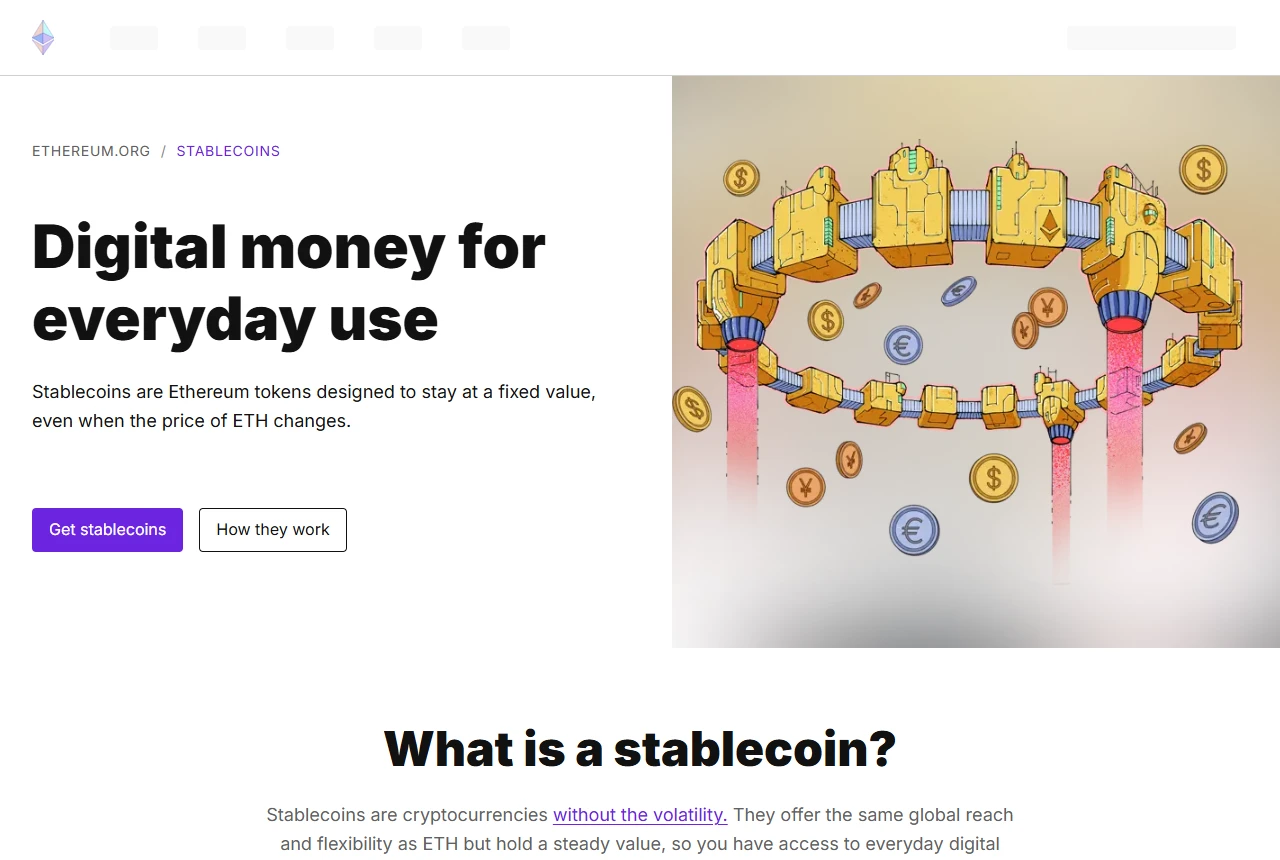
The moment people hear “stablecoin,” their minds tend to split into two camps: either it is a scam, or it is some kind of high yield product. Both extremes miss the point. This piece uses the plainest possible language and treats a stablecoin as the fourth way to hold dollars. Who it is for: people who already understand, or are willing to understand, self custody and basic risk, and who want one more all-hours door in and out of dollar value. Who it is not for: people looking for “which coin will go up, when to buy in.” This piece says nothing about price action, gives no buy or sell advice, and is not an investment recommendation.
The short version first
One sentence: a stablecoin simply puts “dollar pegged value” into a digital container. It sits alongside an offshore dollar account, a multi-currency wallet and brokerage dollars as the fourth way to hold dollars. Its character is all-hours, low cost and high liquidity, and the price you pay for that is carrying platform risk, depeg risk and compliance uncertainty yourself.
It will not rise on its own, and no one can promise it always equals 1 dollar. Treat it as a “container,” not a “yield tool,” and you have got more than half of the angle right. The problem it solves is very specific: when you want a chunk of dollar pegged money that does not depend on one bank’s opening hours, that you can move on weekends and holidays, with a clear and traceable transfer record, it is an option. The problem it does not solve is just as specific: it does not earn money for you, it does not get you around your local rules, and it is not “put it in and it will surely hold value.”
So this piece neither talks you into using it nor talks you out of it. I lay out how it works, where it saves you, what the traps are and what to check before you act, one item at a time. Whether you can use it and whether you should is your call. On whether it is compliant, this site draws no conclusion for any country; go by your local official rules.
What a stablecoin actually is
Take the name apart first. “Stable” is said relative to the wild swings of crypto: the goal is to keep the price hugging some reference point, and the most common reference point is the US dollar, with one stablecoin aiming to be worth 1 dollar. “Coin” means it runs on a blockchain, so it can be transferred and held like a digital asset. The two best known are USDT and USDC, and both use the dollar as their anchor.
So what keeps it hugging 1 dollar? The mechanism is not mysterious. The mainstream approach is called “full reserve backing”: for every coin the issuer puts out, it claims to hold roughly 1 dollar of assets (cash, short term government debt and the like) in reserve, so that in theory you can always redeem the coin for dollars. When the market price drifts slightly off 1 dollar, arbitragers buy or sell to pull it back near the peg. Whether this machinery keeps holding depends on whether the reserves are real, liquid enough, and recognized by regulators, which is exactly the core of the risk section later.
Two lines need drawing clearly here. First, this is not the same thing as “algorithmic stablecoins” that rely on algorithms with no full asset backing; those have historically collapsed to near zero in extreme cases. This piece is about the reserve backed mainstream kind, but even so, reserves are not the same as absolute safety. Second, it is not legal tender, not a bank deposit, and not covered by deposit protection frameworks. Once you understand that layer, you will not mistake it for a “digital bank account,” and you will not mistake it for an asset that appreciates.
How it differs from bank dollars and wallets
Line it up next to the other three containers and the differences are clearest. The table below only shows orders of magnitude. High / medium / low are relative and do not mean good or bad: high liquidity can also come with higher risk.
| Dimension | Offshore dollar account | Multi-currency wallet | Stablecoin |
|---|---|---|---|
| Nature of the money | Bank deposit | E-money | On-chain digital asset |
| Covered by deposit protection | Usually yes | No | No |
| Available hours | Limited by business and clearing hours | Mostly instant | All hours |
| Bar to entry | High | Low | Low |
| Liquidity | Medium | High | High |
| Main risks | Compliance, capital controls, freezes | Not a bank, limits and account bans | Depeg, platform, compliance |
The nature of the money, available regions and redemption method follow what each platform’s own page shows at the time.
Three sentences sum up the division of labor. Bank dollars are the steadiest and usually covered by deposit protection frameworks, but the bar is high and they can be limited by capital controls and business hours. Multi-currency wallets (Wise, Revolut and the like) are flexible and quick to start with, but most are not banks: your money is held as e-money, and the protection works differently from a deposit. Stablecoins put dollar pegged value on a blockchain, and the biggest difference is that they do not depend on any single bank’s opening hours; you can transfer on weekends, late at night and on holidays. The price is that you face platform risk and depeg risk directly, and whether you can use it depends on your local rules. These three are not a case of one replacing another; most people use them in combination by purpose. To run through all four containers as a set first, read this: Where to park dollars: four containers compared item by item, from bar to risk.
The full chain: local money in, out again
Many people feel stablecoins are “technical and mysterious,” but walk the whole path once and it is plain enough. It is three steps in and three steps out:
- Buy in with your local currency. On a legitimate, compliant exchange, after you finish identity verification (KYC), swap your local currency into a dollar pegged stablecoin. The buy price hugs 1 dollar; you have not “invested” in something that will rise, you have simply changed the form in which you hold value.
- It sits in your account. Now it just waits, ready to view, transfer or swap at any time. It does not depend on one bank’s opening hours, which is what “all-hours container” means. You can also move it to a wallet where you hold the private keys and self custody it, kept by you, but that means the responsibility for safekeeping is fully on you too.
- Swap it back when you need to spend or cash out. When you need the money, swap the stablecoin back into local currency and withdraw, or move it to another container. Like buying in, this step is about fees, and about whatever your local rules require for cashing out.
Across the whole chain, what really needs your attention is not “how to operate it,” which the platforms guide you through, but the two ends: whether the platform you picked for buying in is legitimate and compliant, and whether your location allows cashing out and how the fees work. The middle, where it just sits, is the most worry-free part.
Open the exit notice and continue
Where it saves you: cost, time, hours
Put a stablecoin into the context of “holding dollars” and its advantages concentrate on three things, and none of those three is about “how much you can earn.” They are about “how much you save, and how convenient it is.”
Cost. Compared with an international wire that passes through intermediary banks, each taking a cut, plus account maintenance fees, on-chain transfer costs are usually far lower. But note: cheaper is not the same as free. The exchange charges fees to buy and sell, on-chain transfers carry a network fee, and swapping back to local currency may carry a spread. To judge whether it is worth it, always look at “for the same chunk of money, how much lands in the end.” The specific numbers follow what the official page shows at the time; this site does not make them up.
Time. A cross-border wire commonly takes two to five business days; an on-chain stablecoin transfer is usually a matter of minutes. For situations where you are “in a hurry to move money somewhere,” that difference is very real.
Available hours. This is its most distinctive point. Banks have business hours and clearing windows, and on weekends and holidays many operations have to wait; a stablecoin is all-hours, so if you want to transfer at midnight or swap on a Sunday, it is there. For people in different time zones, or whose local currency could move at any time, that “movable any time” is value in itself.
Put the other way: those three savings are bought by carrying more risk yourself. You skip the bank’s bar, and you also lose the bank’s layer of protection. That ledger has to be added up together.
Who it fits, who it does not
A reasonable fit: people willing to spend time understanding account security and the basics of self custody; people who need to move a chunk of dollar pegged money in and out at different hours without relying on a single bank; people already using other containers who want to keep a small amount to test an all-hours door; people whose local rules clearly allow individuals to hold and trade.
Not much of a fit: people expecting it to be an “asset that appreciates” or a “high yield product,” which is a misunderstanding; people who will not carry platform and depeg risk at all and only want the certainty of a bank; people whose local rules do not allow it or are unclear, and who will not check for themselves; people about to put in, right from the start, an amount they cannot afford to lose.
In the end, a stablecoin is not something “everyone should use.” It has the most distinctive risk structure of the four containers: low bar, high liquidity, but little protection and a need for you to understand more yourself. If you have read this far and still cannot tell whether you fall into the “fit” group, the answer is most likely: do not rush, or use only a tiny amount to get a feel for it first. To sort yourself into a slot more systematically, read this: Sort your dollars by amount and purpose.
Check this before you sign up
Before you actually go and register on any platform, run through the items below one by one. They do not guarantee against everything, but they help you block the great majority of basic risks:
- The address bar shows the platform’s official domain, read letter by letter, not a look-alike phishing spelling
- Fees, spreads and available regions follow what the official page shows at the time; do not trust third party screenshots
- No legitimate platform will ever ask you to hand over a password, code, private key or seed phrase
- Turn on two factor verification; keep private keys and seed phrases only somewhere you control, and never send them to anyone
- Use only an amount you can fully afford to lose; run the whole flow with a small amount first before thinking about scaling up
- Whether your region allows individuals to hold and trade is for you to check; this site draws no conclusion for you
Making checking a habit works better than memorizing any single specific rule. For a fuller tick-by-tick list, read this: The last check before you open an account or sign up.
The three main risks, in brief
The more “convenient, all-hours and low cost” something is, the more the risks should be said up front. Stablecoins cannot avoid three kinds of risk. Here is one line on each; how to watch for them and how to check is covered in depth in a separate piece.
Depeg risk. Its value is held near 1 dollar by “reserve backing plus arbitrage,” but that is not a law of physics. When the market doubts the reserves, or in an extreme run, the price can drift off 1 dollar for a while. No one can promise it always equals 1 dollar.
Platform risk. If your stablecoin sits on an exchange or some custodial platform, the risk you carry is that platform’s risk: it could be frozen, restricted from withdrawals, and in the extreme the platform itself could fail. Self custody can reduce this kind of risk, but it hands the responsibility for safekeeping entirely to you.
Compliance risk. Different countries and regions take very different views of stablecoins; some clearly allow them, some restrict them, some are still unclear, and the rules keep changing. Whether you can use it and how depends on your local rules, and this site draws no compliance conclusion for any country.
How to watch these three for yourself, which public information to read, and what the red flags are, is covered in more detail here: When does “1 dollar” stop being 1 dollar: the depeg, platform and compliance risks of stablecoins.
When to stop right away
This is the most common pattern in stablecoin related scams: first they let you taste a little sweetness, or manufacture a sense of urgency that “your account is locked and needs a fee to unlock,” then they lure you into topping up again and again. Remember, your own money does not need another payment to “redeem” it. Watch out just as much for: someone posing as platform support who messages you out of the blue, asks you to click an unknown link, or asks you to read a code or seed phrase aloud to them. The breakdown of these tactics and what to do after being scammed is here: If they want an “unlock fee” before you can withdraw, it is almost always a scam.
How to run a small amount through first
If, after checking, you decide to try it, the steadiest way to start is this: take an amount you can fully afford to lose, run the whole chain once, confirm it all works, and only then talk about scaling up.
- Confirm availability and compliance first. Check whether your location allows it and whether the platform is open to your region. If this step does not pass, none of the rest matters.
- Buy in a small amount. After identity verification, buy a small amount of stablecoin and watch whether the amount received and the fees match what the official page says.
- Let it sit, then make one small transfer. If you plan to self custody, try moving a small amount to your own wallet, get used to keeping private keys and seed phrases, and confirm the address and network are correct.
- Swap fully back to local currency and withdraw. Swap this small amount back into local currency and complete the cash out, confirming the arrival time and fees are within your expectations.
- If all is well, then decide whether to scale up. The point of getting it working once is to expose all the “did not see that coming” traps at a small cost.
This habit is not only for stablecoins. For any container you use to hold dollars, the first time should go exactly like this.
What to read on the official page
When you really get to the point of acting, rather than taking someone else’s word for it, go to the official page yourself and read a few things clearly. Focus on these:
- The fees page (Fees): what is charged on buying, selling, withdrawals and on-chain transfers; read the basis, not just one number
- Supported regions / terms of service: whether your region is on the supported list and whether there are extra restrictions
- The stablecoin’s reserve and disclosure notes: whether the issuer publishes the reserve composition and whether there is a third party report, as a reference for judging depeg risk
- Account security settings: where to turn on two factor verification, a withdrawal allowlist and device management
All fees, available regions and reserve disclosures follow what the platform’s and issuer’s own pages show at the time, and they change over time. This site does not make up specific numbers and draws no compliance conclusion for any country.
Common mistakes
Mistake one: a stablecoin is either a scam or a high yield product. Both extremes are wrong. It is a digital dollar container; it creates no return on its own, and it is not a synonym for fraud. The risks are real, but risk and fraud are two different things.
Mistake two: 1 dollar is 1 dollar, it cannot change. Its value is held near 1 dollar by a mechanism; that is not a law of physics. Understand this and you will take depeg risk seriously instead of assuming.
Mistake three: putting it on an exchange means your dollars are “safely stored.” Put it on any third party platform and the risk you carry is that platform’s risk. However convenient the container, do not pile everything in one place.
Mistake four: whether stablecoins are legal is the same everywhere. Quite the opposite: regions differ a lot, and the rules keep changing. Whether you can use it always follows your local official rules; do not transplant one place’s experience onto another.
FAQ
Sources and updates
This piece explains how a stablecoin works as one way of “holding dollars,” along with its cost, liquidity and risk. It is not investment, tax or legal advice, and it is not a recommendation of any platform or product. For a stablecoin’s peg mechanism, reserve disclosure, fees, available regions and redemption method, go by what the exchange rule pages, issuer reserve disclosure pages and other official pages show at the time; whether it is compliant or restricted follows your local official rules, and this site draws no conclusion for any country. Going to a platform to register through a link on this site does not increase your cost, and the site may earn a commission.
Update note: 2026-06-20. This is the first release. It lays out the stablecoin peg mechanism, the comparison with bank dollars and multi-currency wallets, the full in and out chain, where it saves you, the pre-sign-up checklist and a brief on the three main risks.