Say you have $20,000 you will not need for a year or two. In a savings account it may earn very little. On September 11, 2026, the US Treasury's published rate for 13-week bills was 4.01% on a coupon-equivalent basis. That gap is why many people outside the US move dollars into a brokerage account and buy a money market fund or short-term Treasuries.
What your dollars become inside a brokerage account
Money that reaches a broker and has not been invested is cash in the account. Many brokers sweep that cash into deposits at partner banks at a rate the broker sets; whether it counts as a bank deposit, and whether deposit insurance applies, is spelled out in the broker's cash sweep terms.
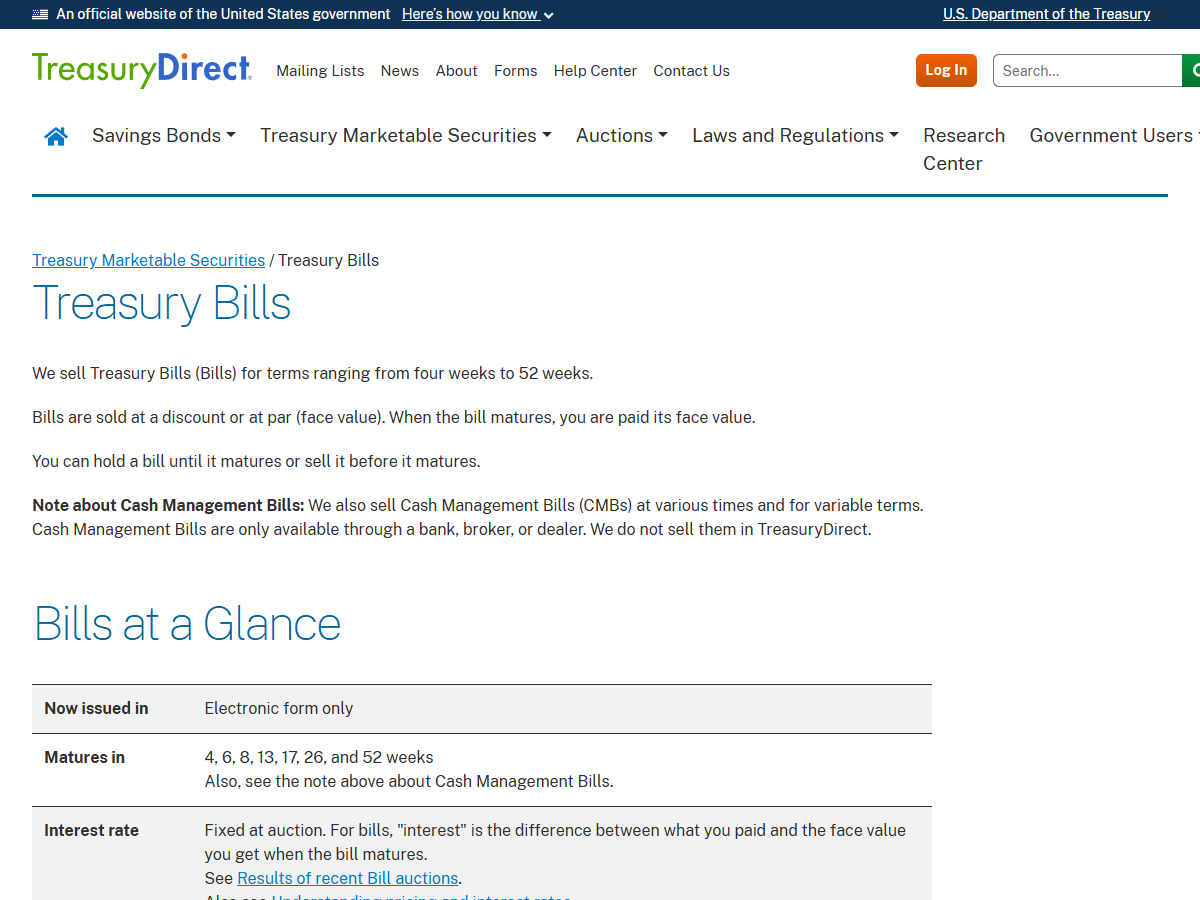
Buy a money market fund and you own fund shares; the fund in turn holds Treasury bills, repurchase agreements backed by Treasuries and similar short-term assets. Buy a Treasury bill and you own short-term US government debt directly. It pays face value at maturity, and its price moves with interest rates if you sell before then.
Neither fund shares nor Treasuries are bank deposits, so FDIC insurance does not reach them. Investor.gov, the SEC's investor education site, describes money market funds as relatively low risk with historically lower returns, but you can still lose money in one.
Funds are easier, bills are cleaner on tax
Both follow short-term US rates. The differences are in what you hold, how tax works and how quickly money comes back:
| Question | Money market fund | Treasury bill |
|---|---|---|
| What you own | Fund shares | The Treasury security itself |
| Term | No maturity; buy and sell on any business day | 4, 6, 8, 13, 17, 26 or 52 weeks |
| How you earn | Income accrues daily, paid monthly or reinvested | Bought at a discount, repaid at face value |
| Minimum | Set by the broker and the fund | $100 at TreasuryDirect; brokers set their own |
| Getting cash back | Usually one or two trading days after a sale | Paid into the account at maturity, or sold early in the market |
| US withholding | Distributions are dividends and may be withheld on | Interest on bills of 183 days or less is outside withholding |
| US estate tax | A US-registered fund counts as US property | Can fall outside US property when conditions are met |
Short bills barely move in price when rates change, and not at all if you hold them to maturity. A fund is more convenient because money moves in and out whenever you like; the trade-off is the fund's expense ratio, already deducted from the yield you see. The last two rows of the table are where bills have the edge, and each gets its own section below.
Discount rate or coupon equivalent: which to compare
The Treasury publishes bill rates every business day, with two figures for each term: the bank discount rate and the coupon equivalent. Part of the table for September 11, 2026:
| Term | Bank discount | Coupon equivalent |
|---|---|---|
| 4 weeks | 3.79% | 3.85% |
| 13 weeks | 3.92% | 4.01% |
| 26 weeks | 4.02% | 4.16% |
| 52 weeks | 4.15% | 4.34% |
The discount rate is based on face value and a 360-day year; it is how bills are quoted. The coupon equivalent is based on the price you actually pay and a 365-day year. When you compare a bill with a bank term deposit or a fund's yield, use the coupon equivalent.
Work one through with a 26-week bill and $10,000 of face value. The discount is 10,000 × 4.02% × 182 ÷ 360 ≈ $203.23, so you pay about $9,796.77 and get $10,000 back 182 days later. Divide the $203.23 by what you paid and scale it to 365 days, and you arrive at the 4.16% in the table.
These are secondary-market quotes collected that afternoon by the Federal Reserve Bank of New York, so auction results and your own fill will differ a little. The yield to maturity on your broker's order screen is the number that applies to your trade.
Which company actually holds your account
Many international brokers open accounts through different companies in different regions. Under one brand, a US client's account may sit with the US company and an Asian client's with a Hong Kong or Singapore subsidiary. Protection follows the company named on your agreement, not the logo.
If that company is a US broker-dealer and a SIPC member, you are covered up to $500,000, of which up to $250,000 can be cash, and money market fund shares count as securities. SIPC does not require you to be a US citizen or resident. It restores assets missing when a broker fails; it does not cover market losses.
An account held by a Hong Kong company falls under Hong Kong's Investor Compensation Fund instead, up to HK$500,000 per investor. It covers only products traded on the Hong Kong exchange and mainland A-shares bought through the Northbound Stock Connect. US stocks, US money market funds and Treasuries bought through a Hong Kong broker fall outside it.
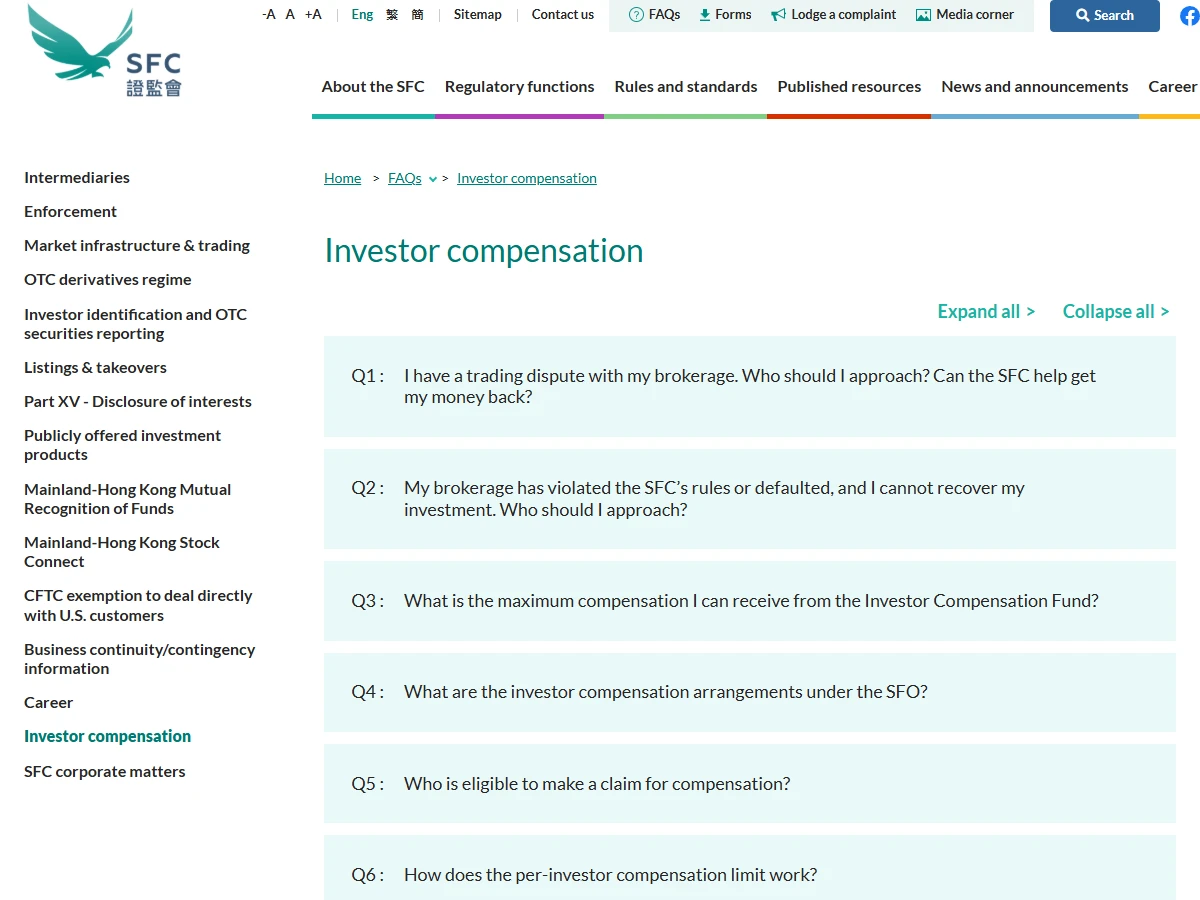
Before funding the account, find the full legal name of the company in your client agreement and look it up on the local regulator's register. The company named there is the one you would be dealing with if something went wrong.
Withholding and the W-8BEN
Most US-source income paid to a foreign person is taxed at 30%, withheld by the payer; that is the starting point of IRS Publication 515. When you open the account the broker will ask for a Form W-8BEN, which establishes that you are not a US person and lets you claim a lower treaty rate if your country has a tax treaty with the US.
The form stays valid from the date you sign it until the last day of the third calendar year after that, so one signed in 2026 runs to December 31, 2029. If you become tax resident somewhere else, tell the broker within 30 days and file a new one.
For bills, interest and discount on obligations that mature in 183 days or less are outside chapter 3 withholding. A 52-week bill runs longer than that and relies on the portfolio interest exemption instead, which again assumes the broker holds a valid W-8BEN for you.
A money market fund pays dividends. The fund can report the part that comes from interest as interest-related dividends, which are exempt for nonresidents; anything not reported that way is withheld at 30% or the treaty rate. Form 1042-S, which your broker sends by mid-March of the following year, shows what was actually withheld.
All of that is the US side only. Whether and how the income is taxed where you live depends on local rules; for larger sums, ask a local tax adviser.
The $60,000 US estate-tax line
When someone who is neither a US citizen nor a US resident dies with more than $60,000 of US-situated assets, the estate has to file a US estate tax return. $100,000 in a US money market fund is already over that line.
The IRS instructions for Form 706-NA say what counts. Stock in US-organized corporations is US property. Bank deposits not connected with a US business, debt that qualifies for the portfolio interest exemption and certain short-term discount obligations are treated as located outside the US.
Shares of a US-registered money market fund are treated like US corporate stock, so they count as US property; Treasury bills held directly do not. That is why some non-US investors buy bills directly, or choose dollar money market funds registered in Ireland or Luxembourg: under the same rule, shares of corporations organized outside the US are not US property.
The US has estate tax treaties with a small number of countries, and those change the picture. If the sums are large, you are older, or you plan to keep money in the US for a long time, one conversation with an adviser is worth having.
From funding to maturity
Fund the account in dollars if you can. Converting at home and then wiring means the spread, the sending fee and intermediary charges take a slice before the money even arrives; how to add those up is in how spreads and fees add up.
Once the cash lands, a fund is bought in shares. A bill can be bought at auction or in the secondary market, and the broker's bond screen shows the maturity date, price and yield to maturity.
At maturity, principal and interest go back to cash. Without automatic rollover the money stays there and earns the broker's cash rate, often noticeably lower. If your broker offers rollover and you want the money to keep moving into new bills, switch it on when you place the order.
To take money out, wire it from the broker to a bank account in your own name; the fee is on the broker's price list. The first time, note how many days it took and what the intermediary bank deducted. For all four ways of holding dollars side by side, see where to hold US dollars.
Common questions
Sources
- US Treasury: Daily Treasury Bill Rates, September 2026
- TreasuryDirect: Treasury Bills
- TreasuryDirect: FAQ on opening an account
- Investor.gov: Money Market Funds
- SIPC: What SIPC protects
- Hong Kong SFC: Investor compensation FAQs
- IRS Publication 515: withholding on nonresident aliens
- IRS: Instructions for Form W-8BEN
- IRS: Instructions for Form 706-NA
- IRS: some nonresidents with US assets must file estate tax returns