On the evening of September 21, 2026, Bank of Taiwan posted a one-year US dollar time deposit rate of 2.05%. On the same day its exchange board showed a gap of 0.67 New Taiwan dollars between the price it paid and the price it charged for one dollar in banknotes. Put those two numbers side by side and a year of interest disappears into a single round trip through cash. The same arithmetic applies to a USD account at any local bank; only the numbers change.
What a foreign currency account is
Most banks let you add a foreign currency sub-account to an existing account, or open a separate foreign currency deposit account; in some countries it is called a domiciliary or FCY account. Once dollars are in it, they work like local-currency deposits: a current or savings balance you can move at any time for very little interest, or a time deposit locked for an agreed term at a higher rate.
Money can reach the account three ways: converting local currency online or at a branch, receiving a dollar wire from abroad, or paying in US dollar banknotes over the counter. Their costs differ a lot, and the sections below put numbers on each.
Compared with a bank account abroad, the bank is close by, local rules apply if it fails, and getting money out does not need an international transfer. The trade-offs are that the rate may be poor and that some countries restrict cash withdrawals and transfers out of foreign currency accounts; for that situation, see holding US dollars under currency controls.
Reading a USD deposit rate board
Banks publish posted rates for foreign currency deposits on their websites. Bank of Taiwan publishes its board in English too, which makes it a useful public example. Its US dollar rates, posted on September 21 and effective from September 18, 2026:
| USD deposit | Standard (per year) | Large amounts (per year) |
|---|---|---|
| Demand | 0.6% | Not offered |
| 7 to 21 days | 0.9% | 0.9% |
| 1 to 9 months | 2% | 2.05% |
| 1 year | 2.05% | 2.1% |
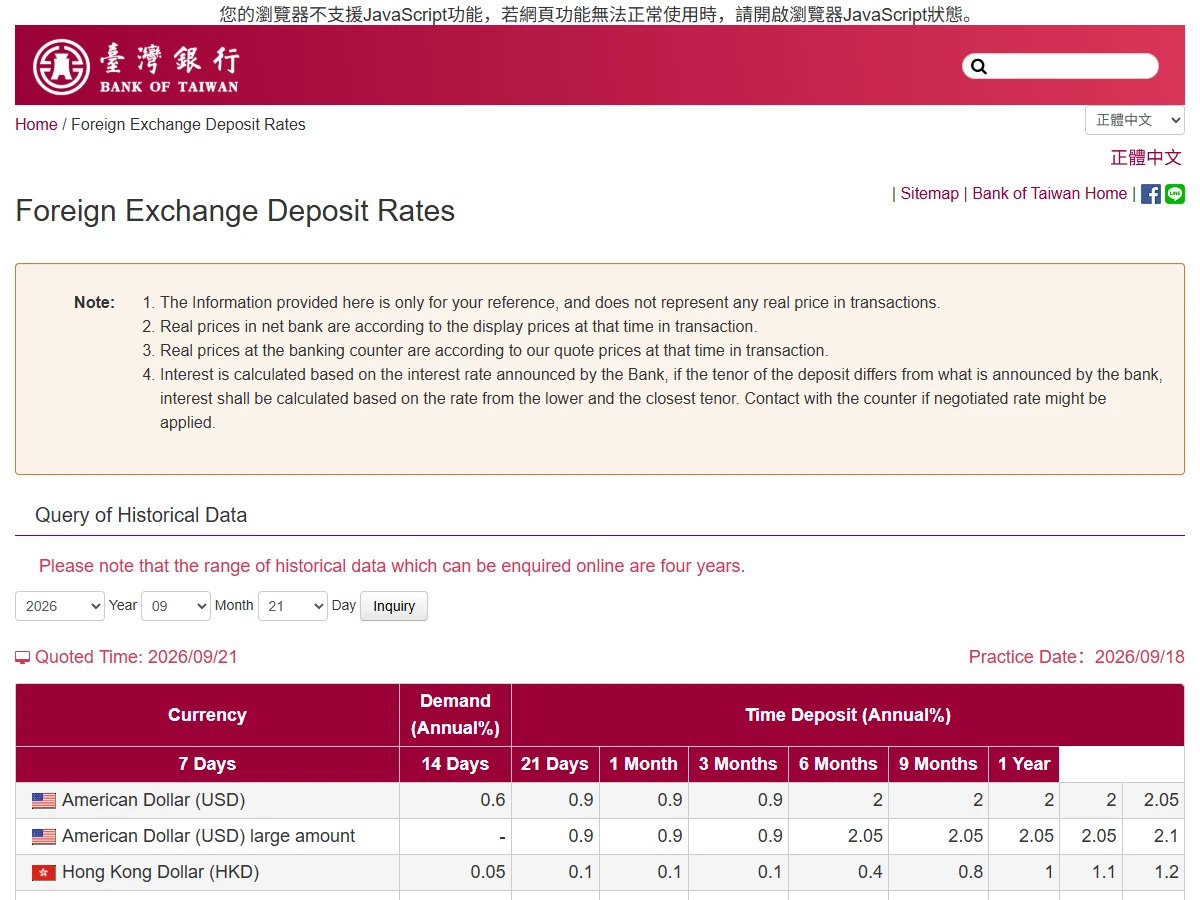
The demand rate is less than a third of the one-month rate, so dollars left in a current account earn almost nothing. From one month to a year the rate barely changes, so a short term pays nearly as much as a long one and leaves the money free sooner. The large-amount premium is 0.05 of a percentage point.
Posted rates are for reference. The bank says the rate shown at the time of the transaction, online or at the counter, is what applies, and that negotiated rates are arranged at a branch. Other banks work the same way: the confirmation screen is what counts.
US short-term rates are much higher. On September 11, 2026, the US Treasury's published coupon-equivalent yield on 13-week bills was 4.01%, close to double Bank of Taiwan's USD time deposit rate. Banks set deposit rates themselves and do not pass on US rates one for one. Getting near Treasury yields means buying bills or a money market fund at a broker, which is no longer a deposit; the differences are in money market fund or T-bills.
The spread can cost more than the interest
Banks post two sets of exchange rates. The spot rate applies to conversions between accounts; the cash rate applies to banknotes. Each has a buying and a selling price: you pay the selling price when you buy dollars and receive the buying price when you sell them back. Bank of Taiwan's US dollar board on the evening of September 21, 2026:
| USD rate (NTD) | Bank buys (you sell dollars) | Bank sells (you buy dollars) | Gap per dollar |
|---|---|---|---|
| Spot (between accounts) | 31.685 | 31.835 | 0.15, about 0.47% |
| Cash (banknotes) | 31.36 | 32.03 | 0.67, about 2.1% |
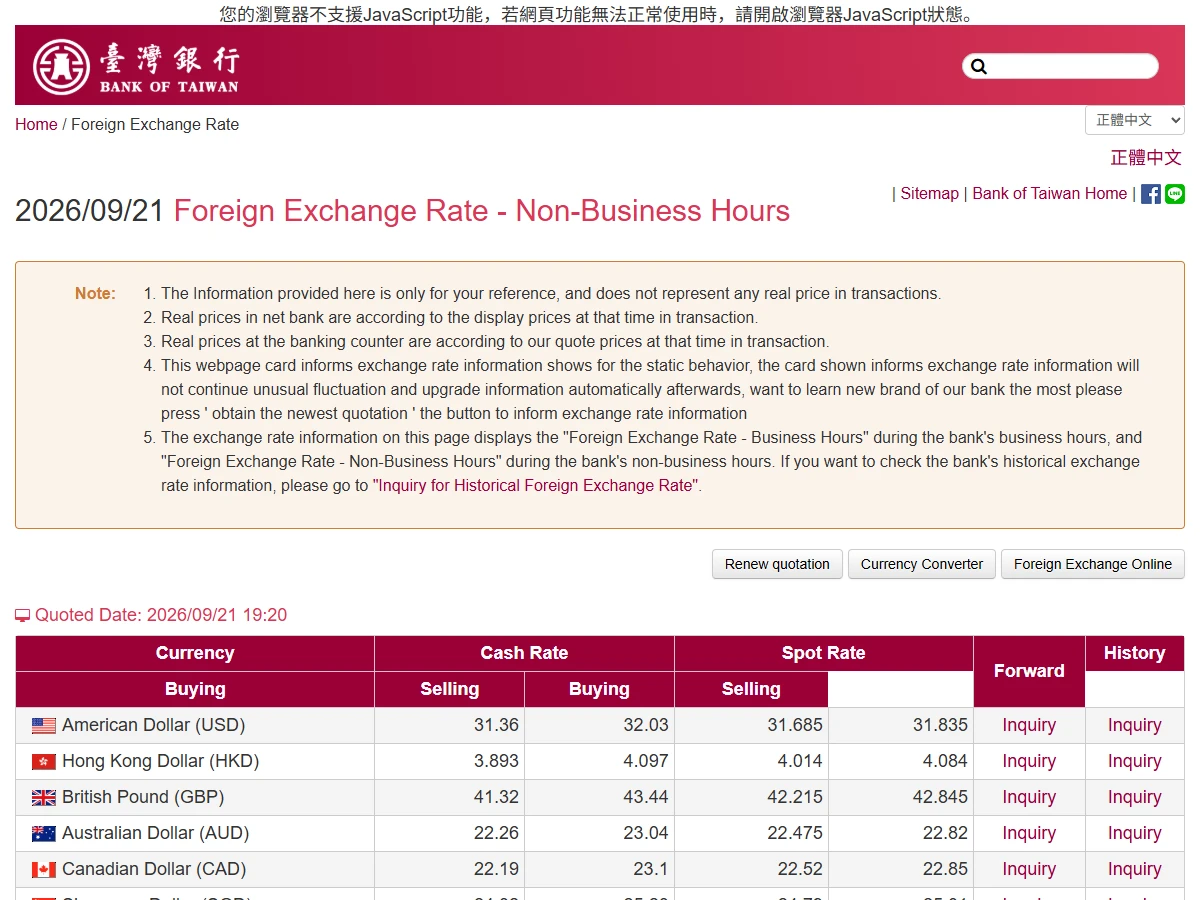
Here is $10,000 in a one-year time deposit at 2.05% both ways, assuming the exchange rate is the same a year later, before any tax on the interest:
| Step | Spot (online conversion) | Cash (buy notes, deposit them) |
|---|---|---|
| Cost of $10,000 | NT$318,350 | NT$320,300 |
| Balance after a year | $10,205 | $10,205 |
| Converted back | NT$323,345 | NT$320,029 |
| Result | about NT$4,995 ahead | about NT$271 behind |
On the spot route the spread takes back about three tenths of the $205 in interest. On the cash route the spread is bigger than the whole year's interest. If you can convert between accounts, leave banknotes out of it; if dollars are coming from abroad, having them wired straight into the foreign currency account beats collecting cash and paying it in. How wire and intermediary fees add up is in how spreads and fees add up.
When the exchange rate moves
The sums above assume the exchange rate stays put for a year, and it will not. Stay with the $10,000: if the New Taiwan dollar rose 3% against the US dollar over the year, the spot buying rate would fall from 31.685 to about 30.734, and $10,205 would convert back to about NT$313,645, some NT$4,705 less than the NT$318,350 paid at the start. A 3% currency move wipes out more than a year of interest.
If your own currency weakens, the deposit gains on top of its interest. Either way, a USD time deposit carries a currency bet. For money you will eventually spend in dollars, such as tuition or travel, the swings matter little. For money you will convert back and spend at home, accept the swings and do not treat 2% as a certain return.
Run the numbers for your own bank
Your bank's figures will differ from Bank of Taiwan's, but the arithmetic is the same. On the bank's website, look for two pages: foreign currency deposit rates, and exchange rates (sometimes called the rate board or FX rates). Write down three numbers: the US dollar spot buying rate, the spot selling rate, and the annual rate for the term you have in mind. The confirmation screen for a conversion in your banking app shows the live price too.
Subtract the buying rate from the selling rate and divide by their average: that is the share of your money a round trip costs. Divide the annual rate by 12 for the monthly interest. The first figure divided by the second tells you how many months the money has to stay deposited before the interest covers the conversion. With Bank of Taiwan's September 21 numbers, the spot spread is about 0.47% and a month's interest about 0.17%, so it takes nearly three months to break even; at the 2.1% banknote spread it takes more than a year.
If the answer is longer than you plan to keep the money there, converting just to earn the interest is not worth it; money you will spend in dollars anyway is a different matter. Remember tax as well. Interest is taxable in most places and some banks withhold it when they pay, so what reaches you is less than the posted rate suggests; follow the rules where you live.
Does deposit insurance cover foreign currency?
Whether foreign currency is covered depends on the rules where the bank is, not on the currency you hold. A few common places:
| Where the bank is | Limit per depositor per bank | Foreign currency | At payout |
|---|---|---|---|
| United States | $250,000 per ownership category | Covered | Converted to dollars at the New York Fed noon rate on the day the bank fails |
| Hong Kong | HK$800,000 | Covered | Time deposits over five years, structured deposits and deposits at offshore offices are excluded |
| Taiwan | NT$3 million | Covered | Paid in New Taiwan dollars |
| United Kingdom | £120,000 (from December 1, 2025) | Covered | Converted to sterling at the rate on the day the bank fails |
| Singapore | S$100,000 | Not covered | Only Singapore-dollar deposits are insured |
The table has two uses. Dollars at a Singapore bank have no deposit insurance behind them. Elsewhere the limit covers local and foreign currency at the same bank added together, so if you already keep a lot in local currency, the dollar part may be over the limit; the excess can go to another bank.
Payouts are converted at the exchange rate on the day the bank fails and paid in local currency. If the rate happens to be against you that day, deposit insurance does not make up the difference.
Products that look like deposits but are not
Ask about a USD time deposit at a branch and you may be offered something with a noticeably higher rate, called a dual currency deposit, a currency-linked deposit or a structured deposit. The extra yield comes with a condition: if the exchange rate reaches a set level at maturity, the bank can repay your principal in another currency, usually at a rate that is bad for you.
These are not ordinary deposits. Hong Kong's Deposit Protection Scheme lists structured deposits among the products it does not protect, and schemes elsewhere generally treat them the same way. If the name includes “linked”, “dual currency” or “structured”, or the contract lets the bank choose the repayment currency, treat it as an investment: find out what currency and amount you would get back in the worst case before deciding.
From opening the account to maturity
Opening a foreign currency account usually needs nothing extra. At a bank where you already have an account it can often be added online; otherwise bring ID and proof of address. Ask two things first: whether the account has a maintenance fee or minimum balance, and whether paying in or withdrawing foreign banknotes carries a charge.
Convert online at the spot rate where you can. Online conversion is often priced a little better than at the counter, and for large sums it is worth asking whether the rate can be negotiated. If you are building up a long-term dollar holding, convert in several steps rather than all at once after the dollar has already risen, so no single price decides the whole amount.
Pick the term by when you will need the money. On the board above, one month and one year pay almost the same, so a short term rolled over is more flexible than a year locked up. Before depositing, read the early-withdrawal terms; most banks recalculate interest at a lower rate, or pay none.
Choose what happens at maturity when you open the deposit. Automatic renewal locks in whatever rate applies on the renewal date; moving to the current account means earning the current-account rate. Forget to choose, and the money can sit at 0.6% for a long time.
Last, add up your local and foreign currency deposits at each bank and compare the total with the local deposit insurance limit, moving any excess to another bank. For how a local bank compares with accounts abroad, brokers and stablecoins, see where to hold US dollars.
Common questions
Sources
- Bank of Taiwan: foreign exchange rates
- Bank of Taiwan: foreign currency deposit rates
- US Treasury: Daily Treasury Bill Rates, September 2026
- FDIC: how deposits in foreign currency are insured
- Hong Kong Deposit Protection Board: coverage
- Taiwan Central Deposit Insurance Corporation: FAQs
- Singapore Deposit Insurance Corporation: scope of coverage
- FSCS: deposit protection limit
- FSCS: converting foreign currency deposits